Stephen Faulkner "A Cheval Donne On R'garde Pas La Brider" (Kebec-Disc, 1980) (LP)
(Produced by Stephen Faulkner & Claude Allard)
Originally recording under the nom-du-twang of Cassonade, Quebecois country-rocker Stephen Faulkner started out in the mid-1970s rock duo, Plume & Cassonade, an eclectic act that had some country influences, but was definitely not a strict twangband. By the late 'Seventies he broken out as a solo performer, recording several singles and at least one LP under the name Cassonade. I think this was his first album recording under his own name, and with a more distinctly country direction and bilingual French-English... There's still a heavy rock flavor, with slick almost glitzy production and an occasionally aggro feel... He comes off as sort of a French-Canadian Vince Gill, with perhaps a hint of Springsteen or John Mellencamp in there as well; definitely in a focussed, commercial orientation. Although this is a little too slick for me, it includes his transliterated French-language version of the Buck Owens classic, "Close Up The Honky Tonks," which is pretty tasty.
Wayne Fehr "Mood Country" (Sunshine Records, 197--?) (LP)
(Produced by Ness Michaels & John Hildebrand)
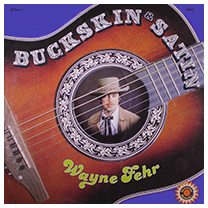 Wayne Fehr "Buckskin And Satin" (Sunshine Records, 1978) (LP)
(Produced by Ron Halldorson & John Hildebrand)
An album's worth of all-original country stuff, recorded in Winnipeg, Canada by a twenty-eight year old songwriter... The liner notes include a testimonial from Jim Zeck, the program director of country station CKLQ, in Brandon, Manitoba. No info, alas, about Fehr's backing musicians...
Troy Ferguson "O'Lunney's Presents Troy Ferguson, Sue Smith & The Country Gentlemen" (O'Lunney's Presents, 1975) (LP)
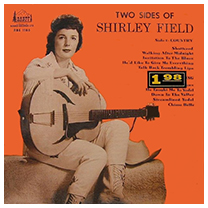 Shirley Field "Two Sides Of Shirley Field" (Banff Records, 1963) (LP)
A Canadian cowgal from Armstrong, British Columbia whose career dates back to the 1940s -- in her early teens Ms. Field was a regional star, playing at rodeos and hosting her own radio show. She landed a gig playing with Evan Kemp's band, then started her own group, the Country Casuals, which she led through the 'Fifties. Later on she and her sister led an all-gal band called the Dartells, while Shirley formed several several long-term duets partnerships over the years. This was her first album, recorded in Ontario after she'd sojourned to Nashville, where she cut a few singles and even played at the Opry the year before. This album featured Kitty Wells-ish heartsongs on one side and yodeling on the other. She's maybe more solid on the yodeling numbers; also, her tutorial on "Streamlined Yodel" might come in handy, if you ever want to take it up sometime.) Ms. Fields is also remembered for her 1965 novelty number, "Ski Rock," a singles-only release which was pretty clumsy but is fondly regarded by some rockabilly retroholics. Following a career that spanned six decades, she was ultimately inducted into the British Columbia Country Music Hall Of Fame in 2006. [Many thanks to 45cat.com for their awesome Shirley Field biography, in addition to info about her singles.]
Shirley Field "Yours Sincerely" (Banff Records, 1969-?) (LP)
(Produced by Dougal Trineer & George Taylor)
Shirley Field & Billy G. French "Together" (Vintage Records, 1972) (LP)
(Produced by Art Snider & Glenn Clarke)
Her lone album recorded with then-husband Billy G. French, a Nova Scotian musician who Fields had a lightning romance with, abandoning her own band in order to form a partnership with him after they married. It didn't last long, which maybe isn't surprising since both Fields and French were, um, challenging singers, particularly French with his off-kilter and deeply corny emulation of Marty Robbins. Together they were definitely no Conway & Loretta. I mean, you want to like them and root for them, but they both sound terribly stiff and self-conscious and even the more interesting songs on here still feel awkward, even with strong backing from veteran players such as with Sebastian Agnello (lead guitar), Larry Dee (steel), Andy Greatrix (bass) and Bobby Munro (piano). The album has its moments, though, with Fields emerging as the bigger talent of the two, if you ask me. The album's clear highlight is her performance on "The Last Time He'll Hurt Me," a bleak, downbeat tune that's positively chilling if taken at face value as a song about domestic abuse. Fields also offers us one of her own originals, a fairly robust honkytonk number called "The Time To Cry," which sits well alongside covers of Loretta Lynn ("You're Lookin' At Country") and Freddie Hart ("Easy Lovin'.") In addition to his odd vocal style, French seems to have been put forth as an instrumentalist, with two breezy instrumentals, "Yellow Bird/Jamaica Farewell" and "Silly Jilly" (a goofy credited to producer Art Snider) were also released as a Billy French solo single, maybe in hopes of generating some like of Harlow Wilcox-like buzz? Anyway, this album is definitely twangy enough to want to check out; just don't get your hopes too high.
First Edition Of The Final Addition "Genuine Country" (19--?) (LP)
Joe Firth "Too Many Memories" (Marathon Records, 19--?) (LP)
Joe Firth "Country" (Boot Records, 1979) (LP)
(Produced by Bob Webster & Curt Allen)
Joe Firth "Me And The Old Promised Land" (Boot Records, 1981) (LP)
Joe Firth "Bottle Of Tears" (Boot Records, 198-?) (LP)
Gary Fjellgaard "No Time To Lose" (Savannah Records, 1986-?) (LP)
(Produced by Howie Vickers)
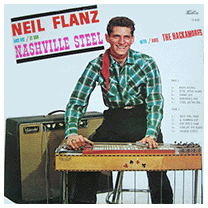 Neil Flanz "...Et Son Nashville Steel" (Trans-Canada Records, 1962) (LP)
The first solo album by steel player Neil Flanz, who anchored the house band of a Canadian TV show called Star Route, which was hosted by Rod Cameron. Originally from Montreal, Flanz toured with Gary Buck and a number of other Canadian country stars before making the move to Nashville, where he worked with several older, more traditionally-oriented artists. Flanz may be best known to modern country fans as a member of Gram Parson's early-'Seventies band, The Fallen Angels, which backed Parsons and his then-protege, Emmylou Harris, on their fabled 1973 tour.
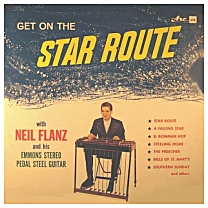 Neil Flanz "Get On The Star Route" (Arc Music, 1964) (LP)
A pleasant set of pedal steel instrumentals showcasing the steel prowess of Neil Flanz, who was still deeply embedded in the Canadian country scene. Of particular interest on this album are the low notes Flanz delves into, as opposed to the standard higher-end tonalities that typify pedal steel work.
Neil Flanz "Special Instructions Album" (Sho-Bud Records, 1972) (LP)
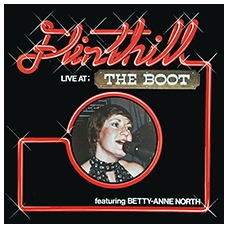 Flinthill "Live At The Boot" (Brothers Records, 1979) (LP)
(Produced by Dennis Thievin, Fran Thievin & Jim Thievin)
A mix of old and new country on this live album, recorded at the Boot cabaret, in Williams Lake, British Columbia. Lead singer and pianist Betty-Anne North is given almost-solo status on the album's cover, but a more democratic inclination won out, and thus we file this one under "F." Only two other members were considered officially part of the band, bassist-songwriter Larry Christensen and drummer Peter Rosk, though several other musicians joined them on the concert, including lead guitarist Don Alden, steel player Randy Pokeda, and Dennis Thieven on keyboards. Along with covers of ABBA and Morris Albert (yikes) this disc is packed with originals -- four songs cowritten by Christensen and North, and three more credited to Ms. North alone. So, maybe we'll forgive them for the covers of "Feelings" and "Fernando..." Or maybe not.
The Fogartys "Hold Your Head Up Newfoundlander" (Audat Records, 1972) (LP)
Though they were celebrating Newfoundland on this disc, The Fogartys were a family band from Windsor, Nova Scotia. The group centered around siblings Debby, John and Mike Fogarty, with Debby Fogarty often spotlighted as lead singer, and John Fogarty the principal songwriter. They were popular in the Maritimes province, but despite cutting several albums they didn't quite break through to national stardom. Their albums alternated between "family" discs and those that presented Debby Fogarty as a solo artist. The Fogartys also worked with the same set of backing musicians on all these albums -- Walter Alward, Glenn Horton, Danny Murray and Roy Thompson -- though sadly wouldn't say who played which instruments. (Also please note: this is one of those groups that was challenged in its use of punctuation -- they consistently spelled their band name as "The Fogarty's," but they were wrong.)
Debby Fogarty & The Fogartys "Since I Met You" (Audat Records, 1972) (LP)
Debby Fogarty "Leavin' Caroline" (Audat Records, 19--?) (LP)
The Fogartys "Canadian" (Audat Records, 1973) (LP)
(Produced by Al Feeney)
A pretty satifying hard-country set with John Fogarty writing most of the songs, and showing a strong debt to Merle Haggard, mostly in tone, though a few songs clearly mimic specific Haggard hits. The title track, "Canadian," is a grouchy patriotic tune modeled after "Okie From Muskogee" (did hippie-era Canada really have a crisis in waning national pride??) while "Dad And Doctor Dave" was almost a straight rip-off of "Daddy Frank." Don't get me wrong: I'm not criticizing them for copying Merle; I think it's kind of neat, and besides they were hardly the only ones. In addition to the deluge of songs credited to John Fogarty, there are also a couple of tracks contributed by their sidemen, including Glenn Horton's "Show Off" and "Rajau Cajun," from Roy Thompson. A solid album, overall.
The Foggy River Band "Foggy River Band" (FRB Records, 1987) (LP)
(Produced by Garry McDonall)
A rootsy band from Kingman, Alberta which was formed in 1984 by some veteran country bar-banders. The group included Rudy Famulak (fiddle), Zigmund Famulak (lead guitar), Lee Penman (drums), Ray Peterson (bass), Vern Peterson (rhythm guitar), and Bobby Wilson (piano). The songs seem to be mostly original material, with the Petersons writing songs, and the Famulaks specializing in instrumentals. Standouts include the Peterson-penned "The Radio Song," and "Beside Me Forever," and regional-pride songs such as "Ballad Of Foggy River," "Edmonton" and "Johnny Canuck And Uncle Sam."
Willie Forbes "Oak Island Story" (The Great Eastern Production Company, 1971) (LP)
(Produced by Al Feeney)
The Four Jacks "Introducing The Four Jacks (Vocal Records, 19--?) (LP)
(Produced by Ernest Klumpp)
George Fox "George Fox" (WEA Records, 1988) (LP)
(Produced by Dan Lowe & Jerry Martin)
George Fox "With All My Might" (WEA Records, 19--?) (LP)
Dave Francey "Jolson Songs Country Style" (Canatal Records, 19--) (LP)
(Produced by Art Snider)
Ray Francis & The Whipporwhills "Country Jamboree" (Arc Records, 19--?) (LP)
Ray Francis & The Whipporwhills "Two Sides Of Country" (Condor Records, 19--?) (LP)
Ray Francis "Good Old Days" (Condor Records, 1975) (LP)
Fraser & DeBolt "...With Ian Guenther" (Columbia Records, 1971) (LP)
(Produced by Craig Allen)
The Canadian folk duo of Allan Fraser and Daisy DeBolt (1945–2011) along with fiddler Ian Guenther...
Fraser & DeBolt "With Pleasure" (Columbia Records, 1973) (LP)
Alex Fraser "Take One" (18 Wheeler Records, 197--?) (LP)
Alex Fraser "At Home With The Alex Fraser Combo" (Self-released, 197--?) (LP)
Alex Fraser "Saskatchewan's Own Alex Fraser Combo" (Self-released, 1975) (LP)
As with their Great Lakes and Great Plains counterparts south of the border, many of Canada's regional dance bands mixed country stuff and polkas, and though the bulk of this album is country material, they found some space to squeeze in a couple of non-twang tunes, like "Beer Barrel Polka" and "The Happy Trumpeter." That's alongside contemporary crowd-pleasers such as "Let Me Be There," "Bed Of Roses," "Proud Mary" and "Somebody Done Somebody Wrong Song." Also a few oldies, like "The Auctioneer" and "He'll Have To Go," etc.
Alex Fraser "Live Sound" (Self-released, 197--?) (LP)
 Ronnie Fray (And The Capers) "Why Not?" (Sound Records, 1968-?) (LP)
(Produced by Johnny Powers)
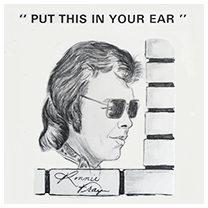 Ronnie Fray "Put This In Your Ear" (Eastown Wreckerds, 1977) (LP)
(Produced by Ronnie Fray, Johnny Powers & Pat Meehan)
An odd and uneven -- but still kinda charming -- album from a longtime member of the Grand Rapids, Michigan music scene. This is an uber-DIY production, notable for its blend of country twang and funky, Southern rock-tinged roadhouse music... Fray is perhaps best compared to Delbert McClinton -- he covers McClinton's "Cold November" and thanks him in the liner notes -- with one foot in the blues/rock and the other in straight-up twang. He was originally from Canada, and moved to Grand Rapids in 1966 while fronting a rock band called the Capers. Gradually Fray established himself as a solo artist and bandleader, and when he made this record he had a regular gig at a Grand Rapids bar called the Eastown Saloon, which helped put out this album. Anyway, this is a nice slice of self-produced roots music... Fray didn't have a killer voice, but his diverse musical tastes and good-natured vibe are pretty compelling. Worth a spin, if you can track it down.
Les Freres Boulianne "Western Evangelique" (Bonanza Records, 197-?) (LP)
Alfie Fromager "Alfie Fromager" (Circle M Records, 1975) (LP)
(Produced by Chuck Goudie & Jury Krytiuk)
Alfie Fromager "Daddy's Girl" (Circle M Records, 1977) (LP)
(Produced by Harry Busby & David Fromager)
Alfie Fromager "Silver River" (Circle M Records, 1978) (LP)
(Produced by Clare Adlam)
David Fromager "Something Special" (Circle M Records, 1977) (LP)
(Produced by Clare Adlam & Jim Evans)
David Fromager "If What You Said Was True" (Circle M Records, 1979) (LP)
(Produced by Clare Adlam)
The Frontiersmen "A Little More Line" (Cascade Records, 197--?) (LP)
(Produced by Bob Stone)
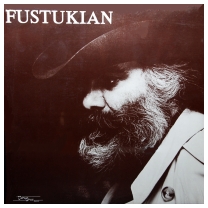 Bryan Fustukian "Fustukian" (Vera Cruz Records, 1979) (LP)
(Produced by Bryan Fustukian & Wes Dakus)
Canadian country singer Bryan Fustukian started his career as '60s pop singer Vik Armen, though he found even greater success as a radio deejay and concert promoter. In the '70s he "went country," and went back to his birth name for a while. This was his first country album, and he sure had a love for the oldies -- real oldies from the honky tonk and pre-honkytonk eras of Hank Williams and Jimmie Rodgers. Amid cover songs such as "Honky Tonk Women," "Red River Valley," "Long Black Veil" and "California Blues," he adds a few tunes of his own, such as "Sing Me A Jimmie Roders Song," "Lonesome Cowboy Song" and "Phyllis (Wait For The Wagon)." Backing him on this disc is his longtime collaborator Wes Dakus, whose 'Sixties band the Rebels was kind of Canada's answer to Cliff Richards & The Shadows... Dakus also went country in the 'Seventies, releasing a string of rootsy records on his Vera Cruz label.
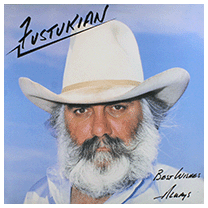 Bryan Fustukian "Always" (Battle River Records, 1980) (LP)
(Produced by Bryan Fustukian & Laurence Pugh)
Bryan Fustukian & The Battle River Band "Live At The Cook County Saloon" (Battle River Records) (LP)
(Produced by Bryan Fustukian)
Buster Fykes/Pam Peddie "In The Style Of Kenny Rogers & Dottie West" (Starburst Records-Canada, 1980)
Starburst Records was a fly-by-night cheapo label based in Peterborough, Ontario which specialized in country music 8-tracks and cassette tribute albums that were cut on the sly by lesser-known twangsters. This particular set sought to capitalize on the duets partnership of Kenny (Sauron) Rogers and Dottie West, who were commercially hot at the time, and is mostly made up of songs they recorded together, though with a couple of random entries thrown in for good measure, such as a cover of Kenny's hit, "Coward Of The County." It was perhaps a sign of how un-seriously the label took its mission that two of the songs were split in half between separate quadrants of the 8-track format. Ouch. Both singers had recorded stuff before this rather unfortunate outing: the elfin-voiced Buster Fykes had been lead singer of a rootsy folk-prog band called Alabama, which released one album back in 1973, while Pamela Peddie cut a country single in '77, though apparently nothing else.
 Canada has long had a vibrant love of country music, often tinged with strong regional pride and songs extolling the great Northern expanse. Some artists, of course, became well-known down south, but for every Hank Snow there are literally thousands of other musicians who never made it to Nashville, or never even tried. At any rate, the Canadian country scene is huge, and deserves to be celebrated in its own right. I'm pretty sure I'm only scratching the surface here, and welcome any recommendations, additions or corrections.

