Bill Anderson - see artist discography
David Ball -- see artist profile
John Berry -- see artist profile
 Blue Ridge Country "Blue Ridge Country" (Mark IV Records, 197--?) (LP)
(Produced by Rusty York)
These guys were from Spartansburg, South Carolina, though they went to the Jewel/Queen City studios in Cincinnati to record this album. Unfortunately, the liner notes don't include any of the band member's names, so they are more of a mystery band than many others... The repertoire is all cover songs, late 'Sixties, early 'Seventies country hits, with a little dip into more pop territory, such as their version of James Taylor's "Fire And Rain." Anyone know more about these folks?
 The Bowery Crew/Loose Change Band "The Bowery Presents Loose Change" (Image Brothers Records, 1984) (LP) (LP)
(Produced by Mike Harbin)
A split LP featuring two southern rock/roadhouse bands from Charleston, South Carolina. The album is a souvenir of the Bowery honkytonk, a Myrtle Beach landmark founded back in 1944 as a country music venue, and best known as the place where the group Alabama cut their teeth as the house band back in the mid-1970s. As near as I can figure "The Bowery Crew," which performs on Side One was an informal agglomeration of the bar's employees (and possibly some patrons?) while the group on the flipside, Loose Change, aspired to more official stature as a working band. Loose Chage was a showcase for gal vocalist Kerry Smith, backed by guitarist George Davis, Richard Rosenblum (drums) Mike Stephens (bass), and Jerry Vann on keyboards and lead vocals. It's worth noting that the Bowery finally ditched their Confederate flag logo (seen on this album's cover) though only in the late 2010s -- and even then they still incorporated the stars-'n'-bars into a new logo featuring a bald eagle with one wing sporting the American flag and the other the Confederate design. I guess that's South Carolina for you... As far as I know this was Loose Change's only record, although all the guys in the band also backed North Carolina folk singer Sally Spring on an album in 1983, and Jerry Vann had some limited success as a country songwriter in the late 'Seventies, with one of his songs, "Reachin' High For Rainbows," making it onto one of Mel McDaniel's early albums.
 Roz Bowie "Dixie" (Bluestem Records, 1987) (LP)
(Produced by Don Johnson & Grover Miskovsky)
An African American female artist... singing Dixie? With the "stars and bars" Confederate flag superimposed over her own picture? Huh. Well, apparently this sort-of country set was an attempt by the conservative-oriented Ms. Bowie to thread the needle between "respectable" Southern pride groups like the CSA/UDC (aka the United Daughters Of The Confederacy) and the more malicious, violent aspects of Confederate symbols and Civil War nostalgia. The inspiration for this album came from the unearthing of a Confederate soldier's long-forgotten corpse at an old battle site in Virginia, and the controversial proposal to erect a Confederate-oriented "tomb of the unknown soldier" monument in South Carolina where the man's remains would be interred. I suppose you could argue this reconciliation was a worthy goal, but I doubt the music has aged well -- the politics certainly haven't. There's not a lot of info out there about Ms. Bowie's career; about half the songs on this album were written by producer Grover Miskovsky and Lyle ("Slats") McPheeters, a novelty artist who recorded a few topically-oriented singles back in the 1970s, including "The Ballad Of Bobby Riggs," a clunky, bizarre defense of the notoriously anti-feminist tennis pro, who got his butt handed to him by Billie Jean King. So there's that, too.
 Bramble "Bramble" (Creative Arts Studios, 1983) (LP)
 Henry Briggs "Henry Briggs Sings... Miss Pauline" (Chandelier Records, 1974) (LP)
(Produced by Leon Malphrus & Henry Briggs)
The Ridgeland, South Carolina team of Henry Briggs and Leon F. Malphrus charged the ramparts of Nashville back in the late 'Sixties, leasing their super-twangy tune, "Miss Pauline" to Decca Records after recording it on an indie, Comet Records. An amiable song with plenty of bounce, their version went nowhere, although a goofy-sounding cover version by Biff Collie (recording under the pseudonym of Billy Bob Bowman) hit the charts in '72, peaking at #55. Turns out that was all she wrote, as they say, though Briggs and Malphrus kept at it, and a few years later they went private label to release this fine set of Southern twang. Of the dozen tracks on this album, eight were originals, with classics by Johnny Cash, Hank Cochran and Dallas Frazier filling in the gaps. Briggs was an appealing performer, with an unpolished vocal style reminiscent, perhaps of Roger Miller or Bobby Bare. Canadian rodeo rider Cody Bearpaw also recorded a version of "Miss Pauline" in 1978, and Mr. Maphrus (1931-2012) wrote some more songs in the '70s, but basically these guys headed back home to Ridgeland, SC after their fling with fame. (One interesting aside: Maphrus's previous claim to fame was getting busted by the feds in 1964 as part of a multi-state moonshine ring, centered in Pensacola, Florida... now that's country!)
 Eddie Brown "Has Anybody Here Seen Sweet Thang?" (DJB Records, 1981) (LP)
All country covers and rock oldies... The label was from Columbia, South Carolina, where I imagine Eddie Brown was a hopeful lounge singer... He's backed by the Rob Crosby group, which didn't include country instruments such as fiddle or steel guitar, but did list woodwinds and both "drums" and "percussion," none of which is a good sign for twangfans.
 Dr. George Ray Bruce & The Quarterwinds "First Set" (Quarterwinds Records, 1983) (LP)
(Produced by Eddie Howard)
An orthopedic surgeon from Seneca, South Carolina, Dr. George Ray Bruce led his band, The Quarterwinds, for several years, making at least one album in the early 'Eighties. It's not all country, though there's definitely some twang in the mix -- along with "Danny Boy" and whatnot, he plays country classics such as "Me And Bobby McGee" and "Welcome To My World," along with more contemporary hits such as Willie Nelson's "On The Road Again" and "The Rose." Dr. Bruce was a beach band musician and jazz trumpet player (uh-oh) and is joined here by other locals, including keyboardist and arranger John Allen, Linda Allen (tambourine), Bob Dennis (lead guitar), Tony Ledford (rhythm guitar), Roger Roach (drums) and Roger Stone on bass. The group was still holding down their residency at a place in Greeneville called Ye Olde Fireplace when they cut this disc; despite the hopeful album title, this seems to have been their only record.
 Mike Calliham "Mike Calliham And The Rough Riders" (Black Stallion Records, 1985) (LP)
(Produced by Johnny Elgin)
Outlaw/drinkin' man's country from a guy with a real Hank Junior vibe ...and the hat to prove it! Mike Calliham (1952-2018) was a lifelong resident of Greenwood, South Carolina who did some touring nationally, but mostly seems to have stayed in his hometown, playing local gigs. This disc is a mix of covers and originals, with three songs penned by Calliham: "Cold Morning Rain," Whiskey Take My Mind" and "I'll Stop Drinkin' When George Does." (Always nice to find another George Jones tribute song and add it to the list.) He also covers Bobby Bare, Guy Clark and Johnny Paycheck, along with two tunes from the Hank Junior catalog. The backing band includes Rusty Barkley (lead guitar), Dale Ledford (bass), Tommy Mooney (drums), Tommy Phillips (steel guitar) and Furman Watson (lead guitar), and while this was recorded in Nashville, I'm pretty sure these guys were all South Carolina locals. Although this may have been Calliham's only recording, there are occasional show notices for performances in the 1990s and as late as 2013.
 Carl & Frank "If The Phone Should Ring" (D&M Records, 19--?) (LP)
(Produced by Bill Huffman & Jack Clark)
A couple of old-timers from South Carolina playing sentimental and old-school country tunes. Carl (Dillard) plays piano while Frank (Martin) handles the vocals, with backing by an uncredited band called The Rhythm Masters... They cover a few oldies like "Born To Lose" and "Wild Side Of Life," though the brief liner notes mention that five of these tracks are their own originals, including (I'm guessing) the title track. A real mystery disc here... any info would be welcome!
 The Carolina Chaparrals "Doyle Wilburn Presents..." (Car-Chap Records, 19--?) (LP)
(Produced by David Boggs & Jack Logan)
A boy band from Belton, South Carolina, the Carolina Chaparrals were kids ranging from ages eight to fourteen, and may have been brothers, although it's hard to tell, since none of them are identified by name on this album. They seem to have been proteges of the Wilburn Brothers, and made at least a few appearances with the Wilburns' road show. The liner notes also mention that they'd made some appearances with the Kendalls, which confirms this as a 'Seventies album, though the exact year remains elusive; they sang a parody of the Johnny Cash hit, "A Boy Named Sue" (in their version, "A Sioux Named Boy") to it was probably in the first half of the decade. Many of the songs appear to be originals, but alas, there are no credits, so that angle is a bit mysterious as well. Also, the clumsily-edited "live" sound of the album's opening track is pretty convincing, the kind of thing where the canned applause of the "audience" drops in pretty hot, and cuts out sharply, with the snip of a razor blade. Still, this is an entertaining album, with an awkwardly raw, pleasantly twangy sound... I also enjoy the plangent, young-kid vocals -- I normally don't enjoy kiddie country albums, but this one has an organic feel, and whichever one of these lads was singing lead was really into it, and sang his little heart out. I'm kinda curious: anyone know what happened to these kids later on? Any of them go on to work in other bands?
Marshall Chapman - see artist discography
 Stormy Clark "One More Time" (Hurricane Records, 1985) (LP)
(Produced by Stormy Clark & Mike Harbin)
Not a ton of info about this very clean-cut, '80s-lookin' fella from South Carolina... I thought at first "Stormy Clark" might have been a stage name for multi-instrumentalist Frank Carlier (who plays bass, flute, guitar, harmonica and mandolin on this album) but it seems like he was actually Harold Harvey Clark, Jr., a lifelong resident of Charleston, who may have actually legally changed his name to Stormy. Most of the songs on this album were his own originals, including several co-written with a guy named Lou Weber (who was not in the band) as well as one by bassist Rodney Stone, and one co-written with drummer Richard Lee Morse. A few tunes make regional references -- "Salkehatchie," "Seagram Seven Queen," "Take Me Back To Carolina" -- and Side Two of the LP includes covers of John Denver's "Leaving On A Jet Plane," Merle Kilgore's "Ring Of Fire," and the Leroy Van Dyke oldie, "The Auctioneer." Stormy Clark & The Hurricanes were one of innumerable groups that took part in the 1986 International Battle Of The Bands talent contest; they also released at least one single on the Hurricane label before cutting this album, a holiday-themed 45 with two songs that were not included here. Clark seems to have recorded this record locally with a hometown crew led by Frank Carlier, along with Art Benton on accordion, Dickie Benton (steel guitar), Mike Bond (bass and guitar), Randy Lucas (banjo), Richard Lee Morse (drums), Andy Norman (steel guitar), George Pearce (mandolin), Edwin Porter (synthesizer) and Rodney Stone on bass and piano. Some of the guys seems to have played in various local rock, country and R&B bands both before and after this album, but as far as I can tell, The Hurricanes, per se, didn't do much in the way of actual live shows.
Ray Cobb "Ray Cobb" (Silver Star Records, 1986)
(Produced by Ray Cobb)
Not to be confused with the Michigan-based bluegrass picker Roy Cobb (leader of Roy Cobb & The Coachmen) South Carolina-born honkytonker William Ray Cobb was a country singer with a string of singles stretching back to the early 1970s. He made regular treks to Nashville for his various recording sessions, with the sole exception being a 1978 "industrial" single he cut for the International Harvester company, recorded along with Colorado's Lee Sims, and he may have spent some time out in the vibrant Colorado/New Mexico bar-band scene. Anyway, this seems to have been his only full album, packed with original material, much of his with an outlaw-ish bent. According to his YouTube and Facebook accounts, Mr. Cobb ran a music venue called Cobb's Corner, located in rural Camp Branch, SC, though I think that may now be long gone.
 The Contenders "The Contenders" (Moonlight Records, 1978) (LP)
(Produced by The Contenders & Dave Robert)
An in-between project formed in Nashville by two members of South Carolina's cult-fave, Uncle Walt's Band... Walter Hyatt and Champ Hood worked with Steve Runkle and other musicians in the Music City orbit to record this album, though they reunited with David Ball later that year to re-form Uncle Walt later that same year, so this album wound up being a one-off event.
Terry Crisp "Burnt To A Crisp" (Gene Breeden Studios, 19--?) (LP)
Like a lot of country folk, pedal steel whiz Terry Crisp came from a musical family: originally from South Carolina, he was related to fiddler Ray Crisp, who worked with Ray Price and Kitty Wells, as well as Brett Crisp, who was also a steel player. Terry Crisp started his professional career in 1969 and steadily worked his way into the Nashville elite, backing mega-stars such as George Jones, Reba McEntire, Ricky Skaggs and Travis Tritt. He also did a lot of small-time, private-press session work, as a go-to picker at the Gene Breeden Studios in Nashville, where he recorded this LP. It's an instrumental showcase album, with stuff like "Kitten On The Bar" (his own take on the classic "Kitten On The Keys") "Orange Blossom Special," a Buddy Emmons tune ("At Ease") and a twangified version of the Jimi Hendrix adaptation of "Somewhere Over The Rainbow." Not sure when this came out -- early '80s, perhaps?
Rob Crosby "Rob Crosby" (Guru Records, 1979) (LP)
One of those folks who plugged away for a long time in Nashville, South Carolina-born singer Rob Crosby found more success as a composer than as a big Music City star. Although this self-released record was cut way back in the disco era, Crosby didn't release his major-label "debut" album until over a decade later, in 1990(!) That set yielded several songs that made the Top 20, but chart success became more elusive with his later work... Still, as a songwriter Crosby was a whiz: his songs have been recorded by superstars such as Brooks & Dunn, Andy Griggs, and Martina McBride, to name a few. Nice work if you can get it.
 Crossrode "Crossrode" (Strawberry Jamm Records, 1980) (LP)
(Produced by Bob Curlee & Crossorode)
Independently produced southern rock by some young dudes from Columbia, South Carolina. This four-piece band included Ken Bolen on bass, Jay DeVine (drums), Barry Keel (lead and rhythm guitar, slide guitar), and Ricky Turner playing lead and rhythm guitar... It's probably not very country, though apparently it is rare and collectable.
 George Elliott "George Elliott" (Elite Records, 19--?) (LP)
(Produced by Fred Carter, Jr.)
A self-released album recorded in Nashville by a middle-aged fella from Greenville, South Carolina... George Elliott had one of those thin, attenuated voices that were a persistent part of the country music landscape for many years, calling to mind singers such as Bill Anderson or Hank Locklin. Despite his apparent lack of vocal firepower, he nonetheless paid for the deluxe package when he headed to Music City, and got a bunch of hotshot studio pros to back him up -- a lineup including Willie Ackerman, Fred Carter, Jr., Buddy Emmons, Hoot Hester, Vic Jordan, Charlie McCoy, and a bunch of other usual-suspect Nashville cats. The production sounds large, modern and bright, suggesting a Don Williams-ish approach, and like Williams, Mr. Elliott may win you over after first seeming like a lightweight. Certainly by the time he hits the album's last song, a sentimental ballad called "You're The One (Who Rewrote My Life Story)," my perspective had shiften in his favor. There's an interesting song selection, with what looks like lots of originals: two by Bill Price, one by Buzz Rabin, a Mel Tillis song, capped off by one of George Elliott's originals, "You Never Seen Me Cry." Fans of the softer, more subtle post-countrypolitan crooners might want to check this one out.
Leon Everette - see artist discography
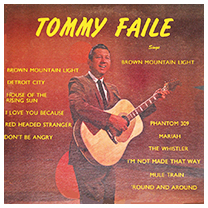 Tommy Faile "...Sings Brown Mountain Light" (CMC/Clay Music Corporation, 1974-?) (LP)
(Produced by Arthur Smith & Charles Andrews)
Although his name might not be immediately recognizable, his music is... Born in South Carolina, songwriter Tommy Faile was an old-school Southern country'n'bluegrass musician who crosed the state line and made his home in Charlotte, working in the bands of Snuffy Jenkins and Arthur "Guitar Boogie" Smith, although he's best known for writing the mega-classic, trucker recitation song, "Phantom 309." Faile includes his own version of the song on here, along with several other originals, and a few covers, including his version of "The Legend Of The Brown Mountain Lights," a novelty number about a will-o-wisp phenomenon in a part of rural North Carolina. Not sure who backed Faile on this album, but it's a pretty good bet that at least one fo the pickers was Arthur Smith himself... Faile also released a slew of indie-label singles in the 1950s and '60s, though as far as I know they haven't been collected anywhere... yet.
Tommy Faile "Full Moon Spell" (Sapphire Records, 1984) (LP)
(Produced by David Floyd)
Tommy Faile "No Fool Like An Old Fool" (Sapphire Records, 19--?) (LP)
(Produced by Tommy Faile & David Floyd)
Hank Garland - see artist discography
 Calvin Gilmore/Various Artists "Calvin Gilmore Presents: The Carolina Opry, v.1" (Candock Records, 1987) (LP)
(Produced by Calvin Gilmore & Jim Rhodes)
A souvenir album of one of the many mom'n'pop "opry"-style variety shows that dotted the landscape over the years... This one was out of Surfside Beach, South Carolina and featured bandleader Calvin Gilmore along with a group that includes Steve Templeton, Janet Smith and others. This one seems to be more of a "band" record, rather than a compilation - many of the same artists play on various tracks. I also think Gilmore may have gone on to become a gospel artist...
 Calvin Gilmore/Various Artists "Calvin Gilmore Presents: The Carolina Opry, v.2" (Candock Records, 1988) (LP)
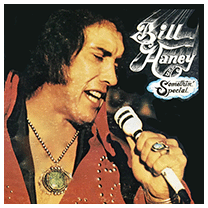 Bill Haney "Introducing Bill Haney With Somethin' Special" (Cam-Lar Records, 1975-?) (LP)
I'm not sure if this is the same Bill Haney from South Carolina who led the early 'Sixties country-jazz-dance band The Dixie Buddys, since there's no address on this album, or the accompanying single, which featured his versions of "You've Lost That Lovin' Feeling" and "Some Kind Of Wonderful." Mr. Haney appears to have been working as an Elvis tribute artist, covering classics like "Promise Land" and "Can't Help Falling In Love" while also dipping into the Righteous Brothers catalog and other white R&B material. An earlier 1972 single of similar caliber was released on a Nashville label, although this seems to have been the peak of his Presleyesque persona. Haney is backed here by organist Jay Johnson, the delightfully-named Mike Plunk on bass, drummer Lanny Swope, and Gene Williams on guitar. Songs include "Can't Help Falling In Love," "Promise Land," "Some Kinda Wonderful," "You Don't Have To Say You Love Me" and "You've Lost That Lovin' Feelin'."
 HipenStrate "HipenStrate" (New Departure Records, 1973) (LP)
(Produced by Tom Porter, Phil Benton & Peter B. Reeves)
Looks a lot cooler than it actually is. The Charleston South Carolina folk duo of Ray Blouin and Dave Hull projected an image of ironic, collegiate cool, although their Smothers Brothers-ish folk/comedy act seems remarkably out of date and late to the dance by the time of this early 'Seventies, Watergate-era release. Recorded partly in the studio and partly live at a Charleston club called the Harbor House, this aims at giving the old folk-revival set list a few tweaks, though most of it falls flat. Of particular interest is a tune called "Father," which is a shaggy-dog comedy bit about a gal whose dad keeps warning her off several boyfriends because they are all secretly his bastard sons from various affairs (hah, hah)... What's most interesting about this track is a topical reference to one of the guys being a hippie loser (hah, hah) and one supposes having the dad be such a big letch was kind of a dig at "establishment" hypocrisies. The album's intended tour-de-force is an immensely prolonged mega-medley called "American Civil War," which patches together countless old ballads and anthems ("Dixie," "Battle Hymn Of The Republic," et.al.) into one big narrative. It's hard to focus on, though, because it goes on and on and on, for maybe ten minutes or so. (Mickey Newberry's "American Trilogy" was bad enough!) The album also includes several original songs, including a few provided by producer Tom Porter; the duo is also accompanied by a guy named Buddy Owens on banjo. Also worth noting that while guitarist Dave Hull should not be confused with fellow folk singer Dakota Dave Hull, he did go on to play bass in an indie-twang band called Wildwood, which produced a self-titled album a couple of years after this disc came out.
 Bobby Holliday "Home Grown" (1976) (LP)
(Produced by Bobby Holliday & Mitch Humphries)
Like countless American kids, guitarist Bobby Holliday was totally blown away when he saw the Beatles play on The Ed Sullivan Show in 1964, then quickly scored an electric guitar, recruited some kids from his Greenville, South Carolina high school, and put together a rock'n'roll band. The group went through a lot of names and lineups, but is best remembered as The Bojax, and under this name they cut a few well-regarded "nuggets"-style garage rock singles that are often anthologized, even though the group never broke through nationally. The Bojax eventually broke up in 1971 when Holiday headed out to California to pursue a recording career. Eventually he returned to Greenville, and among his subsequent musical projects was a stint playing acoustic and country-oriented material, recording two solo albums with a distinctly rural feel. Like a lot of southerners, Holliday moved easily between rock and country influences and was pals with successful local artists such as The Marshall Tucker Band and Jim Stafford; later in life he headed for Nashville and worked as a staff writer for Ronnie Milsap's publishing company, a gig that culminated in a couple of his songs getting placed on an album by the late '90 pop-country band SheDaisy.
 Bobby Holliday "Another Stage" (1977) (LP)
(Produced by Bobby Holliday & Mitch Humphries)
 Mel Isbell "A Good Ole Boy Sings..." (Mark Five Studios, 1975-?) (LP)
(Produced by Jesse Evatte & Pee Wee Melton)
South Carolina-born Mel Isbell (1937-2010) spent years in the 1950s and '60s as the bass player for the Parrish Brothers, a band from Russellville, Alabama that worked in several different cities throughout the Midwest and Great Lakes region. He moved back home in the early 'Seventies and cut this solo album at the Mark Five Studios. Mr. Isbell had kind of a George Jones-ish/Gene Watson-esque vocal style, framed here by fairly goopy arrangements -- perhaps not as "good ole boy"-ish as the album's title would suggest. There's a wealth of original material on here, including three songs by Richard Thorpe, and two by the team of Sandra Waldrop and David Wright. Singer Lois Johnson was a friend of Isbell's before she got signed and started her own career; she contributes liner notes that recall their early friendship. Isbell also did some studio work, including playing bass on Pee Wee Melton's 1983 album, as well as earlier work backing the Parrish Brothers.
 Billy Jeffords "Life Ain't Easy" (Fox-Fire Records, 1982) (LP)
(Produced by Don Dickson & Steve Haigler)
I'm not really sure if this is a country record, though I've seen it listed as one... South Carolina's Billy Jeffords (1948-2016) was known as a "beach music" artist, and tilted more towards rock for most of his career. A former golden gloves boxer and jack of all trades, Jeffords worked most of his career in a partnership with his brother Jackie who wrote or co-wrote a hefty chunk of the songs on this album. The siblings later recorded together as The Jeffords Brothers (in a rock'n'pop mode) and Billy Jeffords also performed and recorded under the pseudonym Dip Ferrell, of Dip Ferrell & The Truetones.
The Jeffords Brothers "Sights And Sounds" (Ray's Records, 1986) (LP)
(Produced by Rod Abernathy & Steve Haigler)
Loose Change Band/The Bowery Crew "The Bowery Presents Loose Change" (Image Brothers Records, 1984) (LP) (LP)
(Produced by Mike Harbin)
A split LP featuring two southern rock/roadhouse bands from Charleston, South Carolina. The album is a souvenir of the Bowery honkytonk, a Myrtle Beach landmark founded back in 1944 as a country music venue, and best known as the place where the group Alabama cut their teeth as the house band back in the mid-1970s. As near as I can figure "The Bowery Crew," which performs on Side One was an informal agglomeration of the bar's employees (and possibly some patrons?) while the group on the flipside, Loose Change, aspired to more official stature as a working band. Loose Chage was a showcase for gal vocalist Kerry Smith, backed by guitarist George Davis, Richard Rosenblum (drums) Mike Stephens (bass), and Jerry Vann on keyboards and lead vocals. It's worth noting that the Bowery finally ditched their Confederate flag logo (seen on this album's cover) though only in the late 2010s -- and even then they still incorporated the stars-'n'-bars into a new logo featuring a bald eagle with one wing sporting the American flag and the other the Confederate design. I guess that's South Carolina for you... As far as I know this was Loose Change's only record, although all the guys in the band also backed North Carolina folk singer Sally Spring on an album in 1983, and Jerry Vann had some limited success as a country songwriter in the late 'Seventies, with one of his songs, "Reachin' High For Rainbows," making it onto one of Mel McDaniel's early albums.
 The Lucas Harmon Brothers Show "Lucas Harmon Brothers Show" (L & H Records, 1970) (LP)
(Produced by Jerry K. Black)
Possibly one of the most confusing band names ever, though they cleaned it up on their subsequent album. You would be forgiven for thinking that this was an album by a guy named Lucas Harmon... Not so. It's actually a collaboration between two different sets of brothers, from the Harmon and Lucas families, joined together in a straight-up bluegrass band that apparently played quite a bit regionally for several years in the late 'Sixties and early 'Seventies... The lineup included bass player Buddy Harmon, Dick Harmon (guitar), Jim Harmon (guitar), Bryant Lucas (dobro), Claude Lucas Jr. (1930-2018) on fiddle, and a banjo player named Bud Lovette to round things out. A swell mix of cheerful, uptempo bluegrass and old-school, pre-honkytonk Depression-era rural twang. Recommended!
The Lucas And Harmon Brothers Show "People, Trains, And Things In Bluegrass" (L & H Records, 1973) (LP)
(Produced by Art Ridley)
Almost a cohesive concept album, but not quite. Side One is all songs about trains, each penned by the band's manager, a Lutheran pastor from Savannah, Georgia, named Marvin Earl Eargle who also contributed a gospel song called "The Living Word," which rounds off Side Two. There are a couple of songs by a fella named Fred Archer, also a pastor, and one tune each by brother David Harmon and James Harmon. The lineup is basically the same as on their first album, with the substitution of David Ayers on banjo. This was apparently the band's last album, though fiddler Claude Lucas Jr. (1930-2018) led his own band for several years after the Brothers Show broke up.
 Marshall Tucker Band "Greatest Hits" (Shout Factory, 2011)
I gotta confess, as a true child of the 'Seventies, even I am surprised at how strong a hold South Carolina's finest, the Marshall Tucker Band, still have on me. One of the most commercially successful Southern Rock acts, these guys softened their sound enough to crack the formula to get into the Pop charts, and tunes such as "Fire On The Mountain" and "Can't You See" remain as effective now as they were when they first came out. There's a bunch of stuff they did on the more rock/boogie/groove end of the spectrum that doesn't really do much for me, but I do like their twang tunes, even after all these years. I also like some of their lesser singles and album tracks such as the Jerry Jeff Walker-ish "Desert Skies" and "This Ol' Cowboy," which I remember hearing on the radio, but didn't realize were from MTB... This is a nice sampler of their work, a dozen-plus tracks concentrating on their best years, and a good introduction to one of the best pop-twang bands of the era.
 Marshall Tucker Band "Anthology: The First 30 Years" (Shout Factory, 2005)
 Linda Martell "Color Me Country" (Plantation Records, 1970) (LP)
(Produced by Shelby S. Singleton Jr.)
Oh, the indignities. That one of the first female African-American country stars should have such a humiliatingly obvious album title... And that it came out on the Plantation label, no less. Anyway, coming at country from a background singing gospel and soul with her family band in South Carolina, Linda Martell (nee Thelma Bynem) is said to have been the first African-American woman to play the Grand Ole Opry... She made a few appearances on Hee Haw in the early '70s, as well, and was a pretty striking performer, with a big, bright voice and cheerful personality. She sometimes drifts into soul-vocals showboating that puts her at odds with the minimalist economy that is more often than not the hallmark of country music craftsmanship... Then again, at the time contemporary big-voiced gals like Lynn Anderson were also pushing against the demure edges of the Nashville Sound, and in retrospect if you stack Ms. Martell's vocals up against the white-soul warblings of more modern stars such as Faith Hill, Wynona Judd or Martina McBride (et.al) it's hard not to see Martell as a groundbreaking artist. I prefer her more restrained performances, but it's all pretty solid, including the top-flight musical backup. Sadly, Martell faced some unsurprising challenges as a black female country artist, ranging from racial harassment at her shows to a major conflict with her management and label: after she confronted Shelby Singleton about what she considered underpayment and lack of promotion, Martell was dropped from the label and Singleton used his influence to blacklist her in Nashville. It's kind of surprising she didn't move into a career as a mainstream pop vocals artist; she certainly had the pipes for it, though I guess she'd gotten her fill of show business after her forays into Music City. Regardless, this album certainly is fine legacy.
Judy McCravy "Introducing Judy" (JBP/Joe Beard Productions) (LP)
(Produced by Bill Green & Joe Beard)
I'm not entirely sure where this gal was from, or when this record was made, but it's definitely a country outing, with covers of hits such as "Stand By Your Man," "Rocky Top," "Silver Threads And Golden Needles," Kris Kristofferson's "One Day At A Time" and "I Fall To Pieces," as well as some gospel standards such as "Amazing Grace" and "I'll Fly Away." She's backed by Jon Carleton (steel guitar, banjo, mandolin), Joe Beard (keyboards, arrangements), Dave Stype (banjo), and Billy McCravy (bass) as well as some trumpet and saxophones... The liner notes doesn't say where she's from, alas, though it's possible she was from Spartanburg, South Carolina, or thereabouts. Any additional info is welcome.
 Ray 'Steel Cowboy' McNeely "...Sings Just For Friends" (Rawhide Records, 1980-?) (LP)
(Produced by Ray McNeely, John Westbrooks & Phil Griffin)
Old-school country classics from a guy from Greenville, South Carolina with a super-cool nickname. The local musicians backing him include Chris Payne (lead guitar), Larry Neely (steel), Donnie Wilson (piano) and Jimmy Rumsey (fiddle). The songs are all cover tunes, including chestnuts such as "Six Days On The Road" and newer hits like "Just Good Ol' Boys," which was a hit for Moe & Joe in 1979. He also covers three Marty Robbins songs and gives Robbins a shout-out in the liner notes, both for his songwriting and for his NASCAR racing.
 Johnny Meeks "Sings Skip A Rope And Other Country Favorites" (Custom Records, 1968) (LP)
Best known as a longtime member of Gene Vincent's trailblazing rockabilly band, the Blue Caps, South Carolina guitar picker Johnny Meeks (1937-2015) went on to work in nondescript groups such as the Tune Toppers and the Champs. He apparently slid into the cheapie-label vortex as well, cutting this album for the Custom label, which seems to include several originals as well as a cover of Henson Cargill's hit, "Skip A Rope." Although these budget-line albums were sometimes packed with not-quite-as-advertised material, this does seem to Johnny Meeks playing and singing on all the tracks, and the material is really, truly great stuff. The chunky, simplistic style he brought to the Blue Caps band is intact here, adding a primitive, old-school rock'n'roll heft to the country tunes and a country twang to the more pop-oriented ballads. Mostly, this is a twangfest, and although there are no composer credits on the album, it seems likely that the originals were all written by Meeks, who wrote several hits for Vincent. Also, there's no info on the session musicians used here, which is a pity... Mostly the arrangements are pretty minimal, but there's some nice pedal steel on a few tunes, and it could have been someone like Red Rhodes doing a pick-up gig... Anyway, Meeks later did some country session work, including a gig picking on Michael Nesmith's 1972 country-rock record, Tantamount To Treason. This solo album, though, was pretty sweet, and much better than you might imagine.
 Pee Wee Melton "...And Some Friends" (Mark Five Records, 1983-?) (LP)
(Produced by Eddie Howard)
Greenville, South Carolina's William C. "Pee Wee" Melton (1928-2000) was a go-to studio guitarist for the Mark Five label, which specialized in some locally-produced country artists and countless gospel albums... This mostly-instrumental album was a showcase for his picking prowess, with contributions from numerous studio musicians he'd worked with over the years, including Bobby Boggs (steel guitar), Mark Burnette (bass), Chuck Gaschler (saxophone), Mel Isbell (bass), Steve Kester (keyboards), Alan Pearson (drums), Jimmy Rogers (mandolin), Jimmy Rumsey (fiddle), Bob Seay (fiddle), Tommy Todd (steel guitar), Johnny Tollison (bass) and many others. Mr. Melton was also a prolific songwriter and booster of local talent -- he particularly encouraged future top forty star Aaron Tippin, who grew up near Greenville, and apparently was a regular guest on the Hee Haw TV show. This seems to be Mr. Melton's only solo album, though he performed on countless records cut by others.
Junne Miller "Foolin' My Heart" (Quintet Recording Company, 19--?) (LP)
Best known as a rockabilly-adjacent hillbilly singer, Joseph ("Junne") Miller's cut a single in 1960 called "How Bad Can Bad Luck Be" that had a rumbling, Johnny Cash-meets-Moon Mullican feel, and has been anthologized on numerous retro collections. Miller is an elusive figure, but seems to have been from Winston-Salem, South Carolina, or thereabouts. Although "Bad Luck" sure sounds country to my ears, Miller wrote it in 1957, when he was part of a package tour called "Kelly Sears College Of Rock And Roll," where he got top billing. He is mentioned in the obituary of a relative, having predeceased them sometime before December, 2018, but no info on Miller himself. This LP is equally obscure -- I've only seen it offered for sale once -- and seems to be Miller's only other record, outside of the "Bad Luck" single.
Jim Nesbitt - see artist discography
John Penney & The Sunshine Express Band "Georgia Lady" (Muscadine Records, 1984) (LP)
(Produced by Paul Hornsby)
Not to be confused with New England honkytonker John Penny (below), South Georgia bandleader John Penney started his country music career in the early 'Seventies, after a stint in the Marine Corps... He led his group for over a decade before cutting this LP and enjoyed modest success on its release. Packed with original material, this was one of several albums produced by the Macon, Georgia-based Muscadine label with producer Paul Hornsby, best known for his work on the southern rock scene, with Capricorn Records, and as a member of the Charlie Daniels Band. As with other Muscadine albums, the musicians are a mix of the artist's own band (in this case, Gary Mixon on bass, Bill Nesbitt playing keyboards, David Royle on lead guitar, and drummer Craig Shugart) and studio musicians provided by the label, notably Randy Howard (fiddle) and David Irwin (steel guitar). Although Penney generated some buzz regionally, he kept his day job running his own construction company, and mostly gave up his country career in the early 1990s. Penney later returned as a Christian country artist, recording several albums of gospel twang while working as pastor of his local church.
The Poplin Family "The Poplin Family Of Sumter, South Carolina" (Folkways Records, 1963) (LP)
 The Poplin Family "Gwine Back To Sumter" (Melodeon Records, 1966) (LP)
 Haden Reed "Pure Country, Old And New" (Reedsound Records, 19--?) (LP)
Dunno much about this fellow... Haden Reed (1937-2006) was apparently from Summerville, South Carolina and had been recording country tunes since at least 1974, when he placed an ad in Billboard for his single, "The Woman Of My World," which he self-released and sold from his home. Mr. Haden passed away in 2006, but other than that he's a bit of a mystery. Anyone out there have more info?
 Haden Reed "A Tribute To Hank Williams" (Reedsound Records, 1981) (LP)
On this album, Reed was billed as "The Black Hank Williams Sr.," so make of that what you will... As with his other LP, this doesn't give a release year or any info about the musicians, although a print ad (in Popular Mechanics, no less!) provides us with the 1981 date. (PS - thanks to Ken at Wildwood Records for the info about this one!)
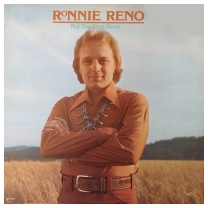 Ronnie Reno "For The First Time" (MCA-Tally Records, 1975) (LP)
(Produced by Bill Compton & Jim Williamson)
In the mid-1970s, country superstar Merle Haggard presided over a corporate echo of Fuzzy Owens' old Tally label, using the imprint to put out a couple of albums featuring Haggard pals and proteges. In this case, it was the solo debut of bluegrass prodigy Ronnie Reno, who became a member of Haggard's band in '73 and stayed with him for the better part of a decade. Ronnie was the son of '50s truegrass legend Don Reno, and worked in his dad's band as a kid, then did a stint with the Osborne Brothers before giving Nashville a shot. At this point in his career, he was writing and pitching songs, some of which Haggard recorded, and here he crafts a pleasant if not totally amazing set of soft-toned '70s country, including three of his own originals and a couple of Hag's lesser-known numbers, as well as a countrypolitan cover of the Beatles' "Hard Day's Night." There's surprisingly little bluegrass influence here (none, really) which makes this album a curious footnote to a long career: Reno went back to the high lonesome sound, forming the Reno Brothers band with his younger siblings many years later.
Len Ridley "On The Banks Of Old Chattooga" (Sounding Board Records, 1980) (LP)
(Produced by Otis Forrest)
An amateur singer from Taylors, South Carolina who specialized in old-time stuff, Len Ridley was apparently a mobile home salesman who played at bluegrass festivals and other gigs in and around Greenville... The liner notes for this album were by Raymond Fairchild, so you know it's the real deal.
 Billy Roberts & Grits "Thoughts Of California" (Tulip Records, 1975) (LP)
(Produced by Hillel Resner & Billy Roberts)
This is apparently the only full album by rock/folk songwriter Billy Roberts (1936-2017) the guy who wrote the '60s beat classic "Hey Joe," a big hit for Jimi Hendrix and numerous other artists. Born in South Carolina, Roberts started out in the Greenwich Village folk scene, and like many East Coasters migrated to San Francisco when the decade got weirder... He played gigs at the hungry i nightclub and was a regular fixture in the Bay Area music scene throughout the hippie era. This record is very odd and idiosyncratic, a real outsider-art kinda thing, but it holds up well. Roberts seems to have had a singular artistic vision: the first time I heard this album, I thought it was a little too folkie for me, but revisiting it I found the country sound was much more prominent than I remembered. Side One of the LP is almost entirely twang, and has a couple of particularly memorable tunes, including the novelty number "Rebound" and the more subtle, gospel-flavored "Hide Behind." That soulful, bluesy vibe gives Roberts a sort of Jerry Lee Lewis-ish vocal quality on several tracks -- Side Two of the album branches out into other styles, not all as successful as the country stuff, though even his goofy white reggae tune has weird, interesting lyrics. Sadly, he was severely injured in an auto accident in the 1990s, bringing his music career to an end. This album's a nice legacy, though... That, and of course "Hey Joe!"
 Billy Roberts/Various Artists "A NIGHT AT THE WINE CELLAR" (Cabernet Recordings, 1976) (LP)
(Produced by Timothy Dawe)
Roberts contributes three songs on this live album, recorded with a passel of folkie artists at the Ghiradelli Wine Celler restaurant in San Francisco. Other artists include Leo Collignon, a band called Good Morning, Skip Henderson, Joey Lent, Jim Nelson, John Palme, Patricia Pickens, Dev Singh, Wayne Smith, and a few tunes by album producer Timothy Dawe. One highlight is the Billy Roberts song "The Grip" about living with alcoholism: "For at last it's come to pass/that the grip I've got on the glass/is nothing compared to the grip/that the glass has got on me..." Mostly this record is packed with painfully earnest folk material, but Roberts' stuff does stand out.
Randy Roe & The Renegades "Bottom Of The River" (Sincere Records, 1971) (LP)
(Produced by Joel Johnson & Ted Pitts)
I wasn't able to track down much biographical information about Vernon A. ("Randy") Roe, though he seems to have lived around Augusta, Georgia and performed regionally, including in South Carolina, where this album was recorded. He put out at least one single under his birth name in the early 'Sixties, with a band called Vernon Roe And The Cherokees, though later he adopted the "Randy Roe" stage name. According to this album's chatty liner notes (written by Opry emcee Grant Turner), Mr. Roe tried his luck in Nashville for a few years, then moved again, and was doing gigs in Augusta, Georgia around the time this album came out. His band included his wife, Louise, on bass and their eleven-year old son Rocky on drums, with outside help from Mike Stirling on lead guitar, and legendary local steel player Bill ("Lefty") Joiner, who was also known for his fiddling. There was at least one single attached to this album, though it included a track called "You Were Right And I Was Wrong," which is not included here. Many of the songs here are Roe's originals, along with some written by his wife.
Gregg Russell "Stars" (Wintersong Records, 1978) (LP)
(Produced by David Wings)
A live album capturing a restaurant show in South Carolina "recorded live under the trees, Harbour Town, Sea Pines Plantation, Hilton Head Island." Includes covers of nominally country stuff such as "Grandma's Feather Bed," "Country Roads" and "Rocky Top," as well as "Love Potion Number Nine."
Gregg Russell "Bridges" (Winter Song Records, 1979) (LP)
(Produced by Gregg Russell & David Wings)
Tilting more towards a soft-pop sound, this nonetheless features the pedal steel work (and saxophone) of David Irwin, along with an unidentified drummer and "all other instruments" played by Gregg Russell. Apparently this time around all the songs were Russell's own originals, including a couple, "Atlanta Lady" and "The Singer's Wife," which he'd recorded on his previous live album. The drums are credited to "DrumDrops," which may have meant Russell used some kind of a drum machine, or pre-recorded rhythm tracks -- there's a whole series of "DrumDrops" albums by a guy named Joey D. Viera, though I dunno if there's a direct connection or not... Gregg Russell recorded at least one other album a few years later, though that one looks so non-country, I think we can safely leave it out of our survey.
Ronnie Satterfield "All Alone" (JJ Records, 1985) (LP)
(Produced by James Tuttle & Stephen J. Mendell)
A demo album by singer-guitarist Ronnie Satterfield, whose day job was as an entertainer on Carnival Cruise Line ship... This set, which was recorded at Cedar Creek Studios, in Austin, Texas, is standard lounge fare, mostly covers of AOR and country-ish hits that were doubtless crowd pleasers: "Margaritaville," Don McLean's "American Pie," Lee Greenwood's "God Bless America," as well as stuff by Dan Fogelberg and Kenny Loggins... There are also three songs written by Satterfield: "All Alone," "Back To Carolina" and "If I Only Had A Girl Like You" and another original, Chris Kingley's "Who'da Believe," using the same publisher (Texas Crude Publishing). The studio crew include musicians such as steel guitarist Jimmy Day, fiddler Johnny Gimble, Stephen Mendell on bass, as well as Lonnie Mack and Ronnie Satterfield playing guitar.
Slewfoot "Live At The Bowery" (Slewfoot Inc., 1982) (LP)
(Produced by David Barnes & Danny M. Hilley)
A working band from Anderson, South Carolina, these folks were playing a regular gig in a Myrtle Beach bar when they cut this record. Looks like a bunch of the songs were originals as well... The group included Janet Bruce (piano and vocals), Phil Bruce (lead guitar and pedal steel), Mark Ensley (bass), Neil McJunkin (guitar) and O'Dell Scott on drums.
 Mike Smith & The All-American Band "Hell Yes I Cheated" (Silver Fox Records, 1983-?) (LP)
(Produced by Jesse Evatte)
This South Carolina band worked for the George Jones "Possum Holler" restaurant chain, circa 1977-78... The liner notes talk about their work "in the last few years" since then, so I'm guessing this is an early '80s album. The title track is a Glenn Sutton song, recorded by numerous artists, with additional songs by Wayne Kemp, Bobby Braddock, and some other intriguing songwriters. Dunno if any of these guys really went on to do much in the music biz, but they had a nice whirl at grabbing the brass ring on this disc...
 Tim Smith "Crazy Man's Dream" (Mad Dog Records, 1979) (LP)
I'm not sure how much of a country twang album we should consider this one, but South Carolina songwriter Tim Smith gives a shout out to John Prine and critiques the glitzier side of fame in "Ain't Gonna Wear No Rhinestones (Ode To Glen Campbell)" so it is kind of in the mix. This was in part a family effort -- all the songs are Tim Smith originals, except for one by his brother, lead guitarist Steve Smith, along with another they wrote together. The rest of the band includes fiddler Bobby Fullbright, Leon Nelson (rhythm guitar), Melvin Odom (bass and guitar), Julie Smith (backing vocals), Janis Trakas (vocals), and Tony Trakas on banjo. I'm not sure if any of these folks played in other bands or on other records, but all the better if you're looking for a strictly local set.
 Southern Crescent Band "Train Time" (USA Records, 1985)
One of several bands using the name "Southern Crescent" in the early 'Eighties. Founded in 1980, this group from Greenville, South Carolina made a go of it in the 'Eighties, releasing two albums and touring regionally before deciding to scale back and become a band-for-hire, rather than trying to make it big on the stadium scene. Their albums are more country and Southern rock-oriented, though later they became more aligned with the "beach music" mellow rock sound of the area. The other Southern Crescent's were a bluegrass band from Virginia, and a similar group from Atlanta, Georgia. Go figure.
 Southern Crescent Band "Peaches" (Axbar Records, 1987)
The Spearman Sisters "Sentimental Journey" (The Spearman Sisters., 1975-?) (LP)
(Produced by Bill Huffman)
A sibling trio from Greenwood, South Carolina, Ann Earline and Floy Spearman took a three-part harmony approach to this set of country hits, which included oldies like "Blue Eyes Crying In The Rain," "Let The Rest Of The World Go By" and "I'm So Lonesome I Could Cry," along with some newer hits like "Country Road" and of course, the big band classic, "Sentimental Journey." This was recorded at a the Mark Five studio in Greenville, with a bunch of the studio's usual-suspect pickers, including Tom Dodd (steel guitar), Bill Huffman (lead guitar), Harold Huffman (bass), Mitch Humphries (piano), Pee Wee Melton (rhythm guitar, and Billy Reynolds on drums.
 Stone Creek String Band "Half A Live At Dino's Lounge" (Scratched Records, 19--?) (LP)
(Produced by Bill Medlin & The Stone Creek String Band)
A South Carolina outlaw-bluegrass band recording one side of the album live at a club in Greenville and one side in the studio. They're bluegrass-y but they cover Emmylou Harris, Little Feat, Steve Goodman and Paul Simon, throw in a version of "I'm An Old Cowhand From The Rio Grande," and include one original, "Her Song," by singer-mandolin picker John Olund. As far as I know, this was their only album.
The Stoney Creek String Band "Half Alive At Dino's Lounge" (Scratched Records, 198--?) (LP)
(Produced by Bill Medlin & The Stoney Creek String Band)
This ragged, twangy band from Greenville, South Carolina took their cues from folks like Gram Parsons and Clarence White, with bar-band bluegrass covers of country-rock classics such as Emmylou Harris' "Amarillo," Little Feat's "Willin'," and Steve Goodman's "City Of New Orleans," along with various bluegrass and old-school country oldies. One of the band's driving forces seems to have been mandolin picker John Oeland, who also contributed the album's one original tune, "Her Song," along with some spirited though chunky solos. In general, these guys weren't what you'd call slick, virtuoso performers, but they definitely were into it and generated a pretty fun vibe. Side One of the album was recorded live at a Greenville bar called Dino's Lounge, which was the band's main stomping ground -- Side Two is a studio set. Also featured are banjo plunker Ken Camp and gal singer/bassist Gail Cook. She sounded a little rough around the edges but enjoyable as a soloist, and definitely had a little bit of a musical crush on Emmylou... though didn't we all, back in the day? A nice example of a lively local band having a lot of fun. The band was together through the mid-1980s, and as far as I know this was their only album.
 The Thomases "Country Side/Gospel Side" (Cumberland Records, 19--?) (LP)
(Produced by Al Bennett & Hal Duncan)
A half secular, half gospel album from the Greer, South Carolina family duo of Carroll Thomas and his daughter Linda, who sings and plays piano, with backing by Luke Brandon (1925-2012) on bass and lead guitar, Donnie Hale thumping the drums, and Stony Stoneciper (1932-2018) on pedal steel. Side One is secular, Side Two is gospel: all the songs are Thomas originals, except for an instrumental version of "What A Friend We Have In Jesus," which closes out the album. Although the Thomases were from South Carolina, they apparently traveled to eastern Tennessee to record this album: the Cumberland label was located in Oliver Springs, Tennessee while Brandon and Stonecipher were both well-regarded local pickers with deep roots in the Knoxville country scene.
Aaron Tippin - see artist discography
Bill Trader "Sings His Songs" (Jim Dandy Records, 1963-?) (LP)
South Carolina songwriter Bill Trader (1922-2003) struck gold with his classic weeper, "(Now And Then) There's A Fool Such As I" which Hank Snow took to the Top Five in 1953, and which was later recorded as a pop hit by Elvis Presley. Mr. Trader never really matched that success, nor did he do much as a performer in his own right. A decade later, encouraged by Charlotte, North Carolina television personality Doug Mayes, Trader put together a dozen songs for this album, where he's backed by a pickup band called the Castaways: Jim Waters, Carroll Dills, Tom Cook, Bill Roberts, and Bob Durham. As far as I can tell, Doug Mayes organized the recording session, though the exact details are probably long lost to the mists of time. The Jim Dandy label was a custom service based in Newberry, South Carolina, run as a sideline by local businessman Jim Davis, who issued about a dozen singles by various local artists, in addition to this one LP by Mr. Trader. (Thanks to the Hillbilly Country blog for info about the label...)
 Buck Trent "Give Me Five" (Boone Records, 1966) (LP)
(Produced by Bobby Bobo and Ray Pennington)
Though he's better known as a bluegrass musician, this album by banjo player Buck Trent fits into the indiebilly canon, mostly due to its novelty orientation... At the time Trent was a mainstay of Porter Wagoner's band, The Wagonmasters, and was renowned for having custom-made an electrified banjo that is featured on this album, to impressive effect. What's most amazing is how little it sounds like a banjo: Trent's deft licks have a much smoother, less plangent, less percussive feel, and if you didn't have the album cover in front of you, you'd probably assume this was an electric guitar album, possibly one of those fuzzed-out numbers they used to sound like sitars a few years later. But nope, it was actually a banjo! This was one of the few LPs released by Boone Records while it was owned by Ray Pennington, and probably uses studio musicians who were in Pennington's orbit (though it's possible some other Wagonmasters were on board as well...) The mainly-instrumental repertoire includes a slew of Hank Cochran songs, as well as several Buck Trent compositions; an unidentified group of female backup singers chime in on the opening tracks, though they recede into the background for the rest of the record. Anyway, it's an odd little album -- I'm sure at the time the whole electric banjo gimmick really wowed folks watching Trent on the Porter Wagoner TV show!
Buck Trent "Five String General" (Boone Records, 1967) (LP)
(Produced by Ray Pennington)
 Uncle Walt's Band "Blame It On The Bossanova" (Lespedeza Records, 1974) (LP)
Although they are often identified with the Austin music scene, Uncle Walt's Band was originally from South Carolina, and was working there when they recorded this album, between stints in Texas. The trio of David Ball, Champs Hood and Walter Hyatt first formed as a high school band 'way back in the early '70s but didn't record this debut album until they'd been together for several years. The band (and bandmembers) migrated to and from Austin a few times over the decade, and also tried their luck in Nashville. All three musicians also pursued solo careers, with Hyatt being embraced as a songwriter by the bluegrass and folk communities, while David Ball had the greatest commercial success, climbing into the Country Top Forty in the 1990s and almost topping the charts on a couple of occasions. But they started their paths as a groundbreaking, ultra-eclectic roots/folk/twang band, pals of Lyle Lovett and favorites of the nascent Austin Americana scene. Some, but not all, of their records have been reissued over the years...
 Uncle Walt's Band "The Girl On The Sunny Shore" (Lespedeza Records, 19--?)
This is a CD reissue of two albums, 1975's "Uncle Walt's Band," and "6-26-79," which originally came out in 1988.
 Uncle Walt's Band "An American In Texas" (Lespedeza Records, 1980) (LP)
 Uncle Walt's Band "Recorded Live At The Waterloo Ice House" (Lespedeza Records, 1982) (LP)
 Don Vinson "A Rose Without Any Thorns" (Masterphase Records, 1986) (LP)
(Produced by Doyle Grisham & Don Vinson)
This appears to be the lone album by South Carolina songwriter Don Vinson, a guy who recorded a string of singles over several decades and made a few inroads into Nashville though mostly seems to have remained a local Carolinian artist. Not a ton of info about this guy out there... Assuming it's all the same Don Vinson, he started cutting singles back in the late 1950s, and was active at least up through the 'Nineties. Mr. Vinson wrote one song, "The Hobo And The Rose," which was recorded by Webb Pierce in 1965, and cut singles for a major label (MGM) as well as several Nashville indies. This appears to have been his only full album, though he had an impressive lineup of talent backing him, including Doyle Grisham on guitar, dobro and steel, Benny Kennerson (keyboards), Richie Simpson (drums), and Glen Worf playing bass. Somewhere along the line, a few years before this came out, Vinson somehow got roped into composing about half the songs on an 1981 album by a really kooky character from Scottsdale, Arizona, named Dennis Smith -- one of many people who claimed to be the secret love-child of Elvis Presley... Despite his long career, there's very little biographical info about Mr. Vinson online -- at least little that I could find.
 Don Vinson "A Southern Time Christmas" (Masterphase Records, 1987) (LP)
(Produced by Robert Bernardini, Joel Johnson & Don Vinson)
 Willis Wade "Introducing Mr. Versatile -- The Fabulous Willis Wade" (Ruby Jean Records, 1969) (LP)
Multi-instrumentalist Willis Wade led this Nashville-based band throughout the 1960s, notably doing several rounds on the USO tour circuit in Europe and Asia. Originally from Blackville, South Carolina, Wade was living in Nashville when he led this group... This late-'Sixties edition of the band included bassist Jackie Lynn (also on vocals), Bob Cox (piano), Ray Salter (drums, bass, guitar and fiddle) and Eddie Weil (bass and drums). Also worth mention is singer Linda Vaughn, who the liner notes identify as "vocalist and dancer" and "short, but cute as she can be." Aw, shucks, that old-fashioned Southern sexism was so darn adorable! This album includes a few originals, including two by Willis Wade, "Cheater Walked Out" and "Wade's Running Banjo"
 Jesse Wales "Songs From The Heart" (Jabbo Records, 1986) (LP)
(Produced by Joe Gibson & Ronnie Light)
A clean-cut, virile-looking fella from Summerville, South Carolina looking very '80s and a little too George Michael for this country boy's taste, but still, this was an outsider country album, and worthy of our attention here. Songwriter and would-be man-hunk Jesse Wales played gigs around the Charleston area, backed by the imaginatively named Charleston Express, which included Jim Byram Jr. on steel guitar, John Rucker (keyboards), Scott Rush (drums), Wayne Salvo (rhythm guitar), and and lead guitar Charles Wiggins. Though this was recorded in Nashville, Wales seems to have had his actual band backing him, as opposed to a for-hire studio crew... The album is packed with original material, mostly written by either Jesse Wales or a guy named Jimmy Fuller (who doesn't seem to have been part of the band... I'll have to dig around a little more to see what I can find out about these fellas
 Mary Ann Walker "Sweet And Wild And Country Style" (The Walker Records, 1977) (LP)
(Produced by Joel E. Johnson)
Not a ton of information about this record, or about this gal from Columbia, South Carolina... The album seems to have been masterminded by her father, Myran Walker, who released a handful of singles on his own "Walker Records" imprint, using the NSD custom label service in Nashville, Tennessee... Though it kinda seems questionably "country" -- the liner notes talk about how this album is "both country and city" -- there are covers of classics such as "I'll Hold You In My Heart," "Mansion On A Hill," and "Rocky Top," and a banjo player in the lineup, so there is some twang in there. The album also includes a couple of original songs written by Myran Walker: "The Bug (That Made History)" and "A New Road Of Love," which were released released together as an NSD single in 1977. Mr. Walker copyrighted a couple of other songs later that same year, and released two different versions of his own song, "Christmas Time Is Jesus Time," recorded by a guy named Kenny Speer, and the next year by John Gardner. Mr. Walker and his business partner Earl Hickman seem to have specialized in recording locals from their hometown of Columbia, and Hickman released several others on his own La Raine label. This seems to have been the record that started it all, with Myran Walker's daughter Mary Ann singing in front of a local studio crew that included David Fuller (drums), Gary Heuer (piano), Randy Lucas (banjo), Warren Moise (synthesizer), Frank Smoak (guitar) and Tommy Toglio (bass) and backup vocals by The Strickland Sisters -- several of these guys played together in a string of local southern rock and country bands, most notably in the Rob Crosby Band, as well as on the Eddie Brown album Sweet Thing.
 Carolyn Watts "Country On The Console" (CMI Records, 1969-?) (LP)
A housewife and church organist from Greenville, South Carolina, Carolyn Watts recorded at least three albums and called herself a "country and western organist," although this seems to have been her only explicitly country record. She played a Conn Deluxe Rhapsody 627 organ, churning out versions of hits like "Folsom Prison Blues," "Games People Play," "Gentle On My Mind," "Green, Green Grass Of Home" and "Ruby, Don't Take Your Love To Town." There's no date on this album, but looking at the repertoire, I'd guess somewhere around 1969-70. Apparently the album was popular enough that she made a second pressing, using a different label name; on one of her other albums, gospel artist Otis Forrest was listed as producer.
 The Wooden Nickel Band "Puttin' It Together" (The Sounding Board, 1983) (LP)
(Produced by Otis Forrest)
An eclectic bluegrass band from Greenville, South Carolina, on my radar as a twangband because they covered both Rodney Crowell and Pure Prairie League's "Aime," which is one of my all-time favorite 'Seventies tunes. These folks are also interesting because guitarist-lead singer Cindy Murphy Orr wrote about half the songs, and yay! women in bluegrass! The Rodney Crowell song is "Shame On The Moon," one of his poppier early works; they also cover Townes Van Zandt's "White Freightliner Blues," and a little bit of Flatt & Scruggs, though mostly this is a pretty modern, forward-facing 'grass group. The rest of the band included banjo player Bill Fowler, Fred Lunsford (bass), Frank Murphy (guitar), and Herman Towles on fiddle and mandolin... Cindy Murphy Orr later fronted a commercial country-pop band called Dixiana, which was together from 1986-93 and placed a couple of singles in the back end of the Top Forty; their last album was a country-gospel offering, which perhaps presaged her work as the leader of an evangelical congregation back home in Greenville.
Various Artists "CALVIN GILMORE PRESENTS: THE CAROLINA OPRY, v.1" (Candock Records, 1987) (LP)
(Produced by Calvin Gilmore & Jim Rhodes)
A souvenir album of one of the many mom'n'pop "opry"-style variety shows that dotted the landscape over the years... This one was out of Surfside Beach, South Carolina and featured bandleader Calvin Gilmore along with a group that includes Steve Templeton, Janet Smith and others. This one seems to be more of a "band" record, rather than a compilation - many of the same artists play on various tracks. I also think Gilmore may have gone on to become a gospel artist...
Calvin Gilmore/Various Artists "CALVIN GILMORE PRESENTS: THE CAROLINA OPRY, v.2" (Candock Records, 1988) (LP)
 Various Artists "THE CAROLINA COLLECTION: 91-AM WORD" (Creative Arts Studio, 198--?) (LP)
Yes, but which of the Carolinas are we talking about?? Well, since this was recorded in Spartanburg, right near the border, there's a good chance these bands were from both states, or at least played gigs on either side. With band names like Animation and Revolution in the list, clearly this was not all country, but groups such as Bighorn (with a song called "Carolina Cowboy") and Lightnin' West add a little hope for us twangfans. Back in the 'Seventies, AM station WORD was Spartanburg's grooviest pop station; in later years they shifted into a format into perhaps more befitting their chatty-sounding callsign: sports talk.
 Various Artists "MUSIC FROM CAROLINA COUNTRY" (United Music World)
(Produced by Dave Craig & Art Ridley)
Hosted by producer-emcee Dave Craig, the "Carolina Country Music Time" show ran on Spartanburg, South Carolina's WSPA TV station throughout the 1970s, with local talent and national stars passing through. This album is all locals, including singers such as Kay Crowe, Donnie Duncan, Bud Holcomb, Don Holcomb, Jimmy Pittman, Daryle Rice, and Eddie Shelton performing a repertoire that looks pretty heavy on original material. They were backed by two house bands with interchangeable memberships, the Country Masters and the Tune Twisters, led by guitarist Phil Lister. Over the years, many local artists appeared on the show, including several who went on to perform on the national stage. This was apparently the first album released under the show's banner... Generally, the vibe is pretty mellow and countrypolitan oriented, with a few clunkily pretentious, poetical songs and some vocals performances that are kind of iffy. But there are also some strong performances on here, and maybe even a few gems... Definitely worth a spin if you want to hear what these low-rent local shows were like.
 Locals Only: South Carolina Twang This page collects artist profiles and record reviews of country music from the state of South Carolina. It's part of a larger guide to unsigned and off-the-radar regional artists from years gone by, which is also part of the even larger Guide To Hick Music on Slipcue.com. Most of the artists here are little-known locals, bar-band singers, etc., but the list also includes Nashville stars who were from the state, as well as some bluegrass and gospel artists, etc. This is an ongoing projects, with new stuff coming in all the time, and we welcome any recommendations, additions or corrections.


