
 Singer/composer/guitarist Tuca (nee Valeniza Zagni da Silva, 1944-1978) is one of the lesser-known but most alluring Brazilian performers of the tropicalia era... She recorded only three albums and a handful of singles, and died quite young in 1978. A rising star in Brazil's mid-'Sixties songwriting festivals, Tuca was one of many artists who fled Brazil after the 1964 military coup due to political reasons which in her case probably also encompassed her queer identity as an "out" lesbian. She moved to France and performed in cafes, and found work as a studio musician: I first learned about her while delving into French pop music when I found mention of her playing guitar on several records by '60s/70s ie-ie pop artists. Although she didn't release many solo works during this period, she was "discovered" by superstar Francoise Hardy, with whom she co-wrote and recorded the album La Question, which was a capstone of Hardy's career. Tuca recorded her final solo album while still living in France (the fascinating Dracula, I Love You) and eventually returned to Brazil. Tragically, she died quite young from a stroke, apparently the result of a radical weight loss program which wrecked havoc with her metabolism. Though hard to find, her records are highly regarded and sought after by fans, while several of her collaborations with other artists can still be found, and are listed here as well.
 Tuca "Meu, Eu" (Chantacler Records, 1966?) (LP)
A fascinating and impressive debut, with Tuca striking off in two directions at once, playing delicate and dexterous bossa nova guitar while simultaneously belting out her vocals in a Maria Bethania-like style. She was a triple-threat artist, though, composing many of these songs herself... Her husky voice was, I suppose, her Achilles heel -- it really is a bit much, although it's also her most distinctive point: hard to mistake her in a crowd. The sometimes-slinky, sometimes brassy arrangements -- apparently by Erlon Chaves -- take a sort of modernist-orchestral twist and it's hard to say whether they compete more with her, or her with them. Often, Tuca seems poorly miked, and blasts past the orchestra, calling attention to her roughness as a performer. This is a technically flawed album, but also quite striking and certainly worth tracking down. Who knows? Maybe the powers that be will dig this stuff up from the vaults and put it on CD someday. Let's hope so,
 Tuca "2nd Colocada No Festival Internacional De Musica: Setor Nacional" (Chantacler Records, 1966) (7")
This single, presumably capitalizing on her prize-winning performance at a different songwriting festival, features two tracks, including "O Calvaleiro," which was co-written with Geraldo Vandre, backed with "Cirandando," which also appears on her Meu, Eu album.
 Tuca "Eu, Tuca" (Philips, 1968) (LP)
Here, Tuca is solidly enveloped in the Philips label's elegant house style -- tasteful arrangements, with well-balanced orchestrations that provide strong accompaniment and perfectly frame her vocals. She still sounds tentative, but the music is solid and quite listenable. Only about half the songs were written or co-written by Tuca, with other including oldies by Ataulfo Alves and newer material from the likes of Roberto Quartin and Mario de Castro... Interestingly, she never seems to have recorded a version of the song, "Porta Estandarte," with which she and Airto Moreira won first place in a 1966 song festival. Wonder why. Anyway, this is a nice album, the most consistent and accessible of her recordings, and definitely worth tracking down.
 Tuca "Negro Negrito/Que C'Est Bon L'Amour" (Philips-France, 1970) (7")
One of Tuca's few solo recordings from her years of French exile, pairing a Portuguese-language pop tune with a jazzy, sensual groove tune sung in French, with both songs co-written by Tuca and Parisian composer Franck Gerald, who worked with top French stars such as Brigitte Bardot, Michel Polnareff and Fran�oise Hardy. Both tracks skirt along the edges of novelty-song status, but also underscore Tuca's charismatic presence -- there's a certain goofiness to her performances which makes these French recordings seem both like missed opportunities and like individualistic gems. These tracks seem more accessible and perhaps more durable than her candomble- themed single, below. Neither single was included on any of her albums.
Tuca "Xango/Umbanda" (Philips-France, 1970) (7")
A wild, challenging single which makes reference to Brazil's African-based candomble religion, with one song ("Xango") credited to Tuca, and the other listed as a traditional or folkloric tune. Tuca's husky, animated, half-shouted vocals have an almost punk-rock feel to them; the accompaniment is heavily percussive and perhaps a bit awkward though the clumsiness adds to the sense of unruliness and misbehavior. There are no musician credits and it's not clear if the backing musicians were also Brazilian expatriates or French ringers; also unclear is whether Tuca herself was an umbanda practitioner or a musical dabbler. Not as pleasant-sounding as her other works, but intriguing and unusual.
 Francoise Hardy "La Question" (Sonopresse, 1971) (LP)
(Produced by Rene Ameline, Bernard Estardy & Tuca)
Dreamy and languid, with Francoise softly ululating to the sparing accompaniment of a flamenco-tinged guitar and delicate string section. Tuca co-produced and performs on this album, which is quite lovely, and said to be one of Hardy's personal favorites. Especially fun are the tracks where Hardy and the guitar "accidentally" fall out of synch with each other... a gentle jarring of a genteel sound. Highly recommended!
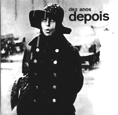 Nara Leao "Dez Anos Depois" (Philips, 1971) (LP)
Beautiful. On the face of it, this 2-LP collection is just all the same-old, same-old bossa nova classics, except that Leao manages to place a very distinctive stamp on each song, and make them sound bright, fresh and new. Perhaps is has something to do with the sessions recorded in France -- a euro-chanson sensibility, perhaps? At any rate, the spare arrangements and distinctive acoustic accompaniment by guitarist Tuca make this one of the best latter-day bossa nova records out there. If perhaps you've ever wearied of hearing the same damn Jobim songs over and over, give this album a try... it may make the classics seems fresh again!
 Tuca "Dracula, I Love You" (Som Livre, 1974) (LP)
(Produced by Tuca & Mario De Castro)
(Arrangements by Christian Chevalier & Francois Cahen & Tuca)
Awesome album title. Her last record, produced in France, was a pretty trippy disc, reflecting the eclectic vibe of the early '70s while making the most of the orchestral sleekness and precision of her Gallic hosts. On the front and back covers, Tuca is made up in Hammer horror-movie glam, and the record is about as weird inside as out... Her voice is as husky as ever, but finds a nice match with the swelling, sometimes challenging arrangements, sophisticated stuff but also with touches of the avantnik tone of Brazilian tropicalia ala Rogerio Duprat. I've only heard this one in bits and pieces, but I'd say it's probably her most accessible album and certainly the most in need of modern-day reissue. C'mon, powers that be, what are you waiting for?


