
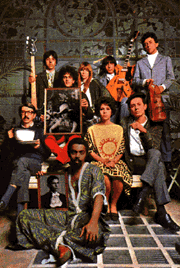
 was a late-'60s/early-'70s musical movement that combined North American rock, blues, jazz, folk and psychedelic music with Brazilian and other latin american styles. Closely identified with youth and counterculture, tropicalia was the most visible part of an artistic movement that sought to redefine Brazilian culture, and actively helped subvert the military dictatorship which had taken over the country in 1964. In part, tropicalia was also a reaction to the perceived stodginess of bossa nova music, which had been the dominant pop style since the late 1950s -- it was also seen as an alternative to the industry-sponsored prefab teenybopper rock of the jovem guarda... Both tropicalia and bossa nova have come to be referred to as part of MPB, or "Musica Popular Brasileira," modern Brazilian pop, though the term originally applied only to tropicalia.
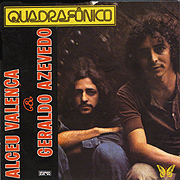 Geraldo Azevedo & Alceu Valenca "Quadrafonico" (Copacabana Records, 1972) (LP)
There are quite a few recent reissues of lost "psychedelic classics" coming out of Brazil and the rest of South America these days... This is one of the stronger releases you'll come across, the debut album by two of Brazil's biggest "regional music" stars of the 1970s and '80s. Hailing from Pernambuco, Azevedo and Valenca worked for a few years together as a duo, performing in the popular song contests that many artists used to launch their careers back then. This disc shows them very much in debt to the avant-rock of the tropicalia crowd, even working with composer-arranger Rogerio Duprat, who adds the same sheen of highbrow avant artsiness (musique concrete, atonality, etc.) that he brought to seminal albums by Caetano Veloso, Os Mutantes and Gilberto Gil. There's also a rich strain of melodic acoustic-folk, with a distinctive regional flair. Both artists went on to record solo "debuts" that were less effective than this disc, but here there's a real magic, a skillful, challenging mix of both wild and understated... Nice balancing act, great record.
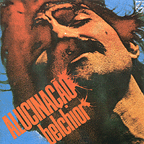 Belchior "Alucinacao" (Philips, 1976) (LP)
An iffy effort by one of the early pioneers of Northeastern rock music... At heart this is pretty tame stuff, and his nasal vocals are... well... different. The most interesting aspects are some '70s folk rock/country touches (subtle pedal steel, some acoustic guitar), a dash of forro... and baiao... But mostly this is not mind-blowing. It sounds kinda like a Brazilian tribute to "Yellow Submarine" -- the song, not the album. Still, this guy was important to the development of a homegrown rock scene... Or so I'm told...
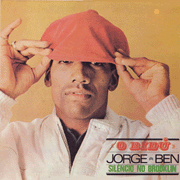 Jorge Ben "O Bidu: Silencio No Brooklyn" (Artistas Unidos, 1967) (LP)
Although Jorge Ben was not an "official" member of the tropicalia scene, this late-'60s album, released before Caetano Veloso and Gilberto Gil made their first big splash, had a huge impact on the way the future tropicalistas thought about the mix of Brazilian music and other styles. For starters, it's a gorgeous record! Layered, lavish production, mixing '60s psych, blues and Herb Alpert-style pop with killer African percussion and slinky samba rhythms. One of Ben's best, most creative and catchy albums, and worth looking hard for. Apparently, the backing band on this album is the rock-pop outfit, Os Fevers... at least that's the rumor... (Unfortunately, the mastering on the 1992 Movietone CD is a bit thin on the fidelity, though still worth picking up...) In his autobiography, Tropical Truth, Caetano Veloso talks at great length about this album, how it anticipated many of the genre-crossing feats that the tropicalia crowd wanted to try, and how greatly he and Gilberto Gil admired Ben's amazing musical vision. Even with the crappy sound quality of most CD reissues, this disc is a must-have.
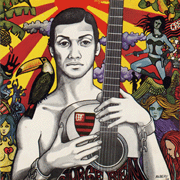 Jorge Ben "Jorge Ben" (Philips, 1969) (LP)
(Produced by Manoel Barenbein)
(Arranged by Jose Briamonte & Rogerio Duprat)
An excellent album, with some of his catchiest songs, many of which often make it onto best-of compilations. Wildly inventive, syncretic, experimental pop music, ranging from San Francisco-sound psychedelia to spaghetti western schmaltz, and deep, heavy samba-soul. The album is both soulful and playful, as when he sings the last half of one song in a funny voice, with his nose pinched shut, or when the string section veers into bent-note atonality. The album art shows Ben with the emblem of the Flamengo futbol team on his guitar, and broken manacles on his wrists -- the latter presumably a powerful statement about the military dictatorship which was running the country at the time, and actively trying to repress the tropicalia movement. One of his best records... definitely worth tracking down!
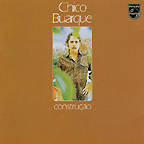 Chico Buarque "Construcao" (Philips, 1971) (LP)
I'm fairly sure that songsmith Chico Buarque was never considered part of the tropicalia movement, but thus dense, challenging album is certainly worth checking out in connection to that scene... It's a baroquely crafted, dark, somewhat foreboding album which marks an abrupt switch from his earlier, mellower, post-bossa balladry. The opening tracks have an eerie tension to them, embedded within compelling, expressive pop arrangements that fans of complicated film music may want to check out! Gradually the music eases up, and the disc gallops to an all-too-quick finish. Intense and recommended -- an excellent example of the lavishly creative music being created in early-'70s Brazil. Many consider this disc, with its tightly interlocked lyrical and musical elements -- and pointed social critiques -- to be one of Buarque's major works.
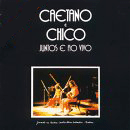 Chico Buarque & Caetano Veloso "Caetano E Chico Juntos E Ao Vivo" (Philips, 1972) (LP)
And here's Buarque in collaboration with the clown prince of the tropicalia crowd... A very good concert album, recorded after Veloso had just returned to Brazil from his London exile, and the pairing of this upstart tropicalista with the once-reigning king of the late-'60s MPB scene was seen as an important merging of two artistic-social scenes that were once at odds, but were now united by the need to (subtly) stand up to the onerous military regime. Still, Buarque's performances seem a bit too declarative and stiff, while Caetano's soulful acoustic salvos on Side One, and his rendition of "Os Argonautas" at album's end, are all quite delectable. Can't say as I care for their duets much, though: there's sort of a square peg element at work there. Worth checking out, though, as it has several lovely tracks and a nice overall feel.
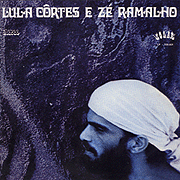 Lula Cortes & Ze Ramalho "Paebiru" (Rozenblit/Mocambo Records, 1974) (LP)
Northeastern rock pioneer Ze Ramalho plays various instruments on this aggressivley experimental pysch/prog/avant rock album, backing Lula Cortes of the Brazilian psych band Satwa... For many, this is a lost treasure of Brazilian acid rock; I just found it to be tremendously irritating and jaggedly textured. If your taste in jazz tilts towards improvisational "free jazz," where constantly pushing against the envelope is an end in and of itself, then this album might be a real treat... Personally, I like a little more melody. (So I'm square; sue me, daddy-o.) This is an interesting historical relic, I suppose, but I far prefer the spacey folk-rock of Ramalho's first few solo albums...
Gal Costa - see artist discography
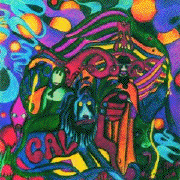 Gal Costa "Gal Costa" (Philips, 1969) (LP)
A heavily rock-flavored, psychedelic album, with a hefty dose of Philly soul thrown in on top. Lots of Summer of Love-y San Fran-sound electric guitars and powerful percussion. Most of the songs are by Caetano Veloso, Jorge Ben and Gilberto Gil, and Gil and Veloso pitch in one one track. Sometimes Gal wails crazily, other times she's crooning sweet as honey... This is definitely one of her best, most experimental albums. Crazy, but lots of fun.
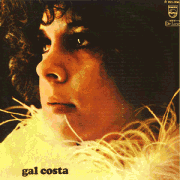 Gal Costa "Gal Costa" (Polygram, 1969) (LP)
The cover features Gal in a feather boa and tons of mascara... Again, this is very challenging, aggressively experimental pop. Manic electric guitars and Costa's swooping, yowling, vocals might be a bit off-putting at times, but the album is balanced with several lovely tunes written by the usual suspects. Not for everyone, and not for every mood, but definitely recommended.
 Gal Costa "Legal" (Philips, 1970) (LP)
Other than the acoustic/electric live album which followed it (A Todo Vapor, below) this is probably Costa's best tropicalia era album, running the gamut from jazzy space rock to sweet ballads and driving acid rock. The title is a slang word which means, roughly, "cool," which is appropriate to the groovy vibe within... Side One kicks off with a glitzy '50s rock rave-up that would have made Elvis' Vegas band proud, and slides right into "Lingua Do P," a canny funk-forro fusion that is one of her all-time best tracks. "Love, Try and Die" is a disturbing patch of folkie darkness worthy of Tom Rapp or Tim Buckley, and throughout Costa keeps the momentum going. This isn't as cacophonous or abrasive as her other, earlier rock albums, but it's still really trippy and psychedelic. Highly recommended!
 Gal Costa "Gal A Todo Vapor" (Polygram, 1971) (LP)
This is probably my favorite Gal Costa album. A supple, gorgeous live album; one of the finest records of its era that I've heard. The first half features Costa's youthful, sparrowlike voice is at its softest and best, accompanied only by an acoustic guitar and the applause of her entranced audience. Midway through the album, a lively -- though slightly comedic -- Cream-like heavy rock/jazz accompaniment kicks in, while Costa keeps crooning. Features an excellent selection of early tropicalia and plaintive ballads -- altogether, a canny study in the stylistic range of MPB.
 Gal Costa "India" (Philips, 1973) (LP)
An intriguing, almost math-rocky mix of her crooning and crazy sides. This isn't as manic as the earlier, overtly psychedelic albums, but with arrangements by Gilberto Gil, and an elite crack team of Brazil's best chipping in on the backup, it's well worth checking out. Particularly noteworthy are the accordion riffs by Dominguinhos, which at times are restrained enough to sound almost like French musette. Other guests include tropicalia mastermind Rogerio Duprat, bossa nova architect Roberto Menescal, and jazzmen Tenorio, Jr. and Wagner Tiso. A lot of this album is off-kilter and hypnotic, particularly the loopy, loping beats on "Relance" (a Caetano Veloso song) and the halting rhythm on "Da Maior Importancia." It's a goody. Highly recommended.
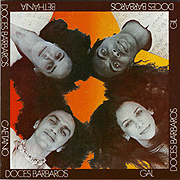 Doces Barbaros (Maria Bethania/Gal Costa/Gilberto Gil/Caetano Veloso) "Os Doces Barbaros (The Sweet Barbarians)" (Philips, 1976) (LP)
A live reunion of "the group from Bahia"... the leading lights of the tropicalia movement. This is an upbeat, though manic, performance, deeply influenced by contemporary jazz-funk fusion, but with a distinctive Brazilian flavor.. The vocals are charged with enthusiasm and joyfulness, but are still raggedy and at times a bit grating, particularly Costa and Bethania. Not surprisingly, the calmest, most compelling moments are Veloso and Gil's -- but everyone's so edgy you can't help but wonder if all four were on something that night. (Anything's possible, I suppose...) Underneath it, though, is a powerful musical vigor -- the band is tight, the funky arrangements are sharp and inventive, and in many ways this can be seen as the last blast from the peak years of Tropicalia's immense impact on Brazilian culture. Definitely worth checking out, though a little hard to listen to recreationally.
Rogerio Duprat - see artist discography
Gilberto Gil - see artist discography
Rita Lee - see artist discography
Os Lobos "Miragem" (Top Tape, 1971) (LP)
A cool mix of styles - jangly pop-psyche, denser, jazzier proggish art-rock and bouncy, piano-led music-hall shuffles, reminiscent of The Kinks. The alternating male-female vocals invite comparison to Os Mutantes... Personally, I like these guys better: their artistic output is more consistent and they seem a little less full of themselves. A great hippie-era relic!
Jorge Mautner - see artist discography
Os Mutantes - see artist discography
Novos Baianos - see artist discography
 Ze Ramalho "Ze Ramalho" (CBS Records, 1978) (LP)
Cool. A really interesting, mellow, slightly off-kilter folk-rock album, combining northestern forro and sertanejo stylings with spacey folk-pop along the lines of Tim Buckley and Bob Dylan... His rambling, discursive style comes off a bit Dire Straits-y, too... and I mean that in a good way! A couple of tracks are co-written with fellow NE rocker, Alceu Valenca... other guest artists include Vinicius Cantuaria, accordionist Dominguinhos, samba bad boy, Bezerra da Silva, ex-Mutante Sergio Dias and -- of course -- forro-pop superstar Elba Ramalho... An all-star cast for a very intriguing album. Recommended.
 Ze Ramalho "A Peleja Do Diabo Com O Dono Do Ceu" (CBS Records, 1979) (LP)
The cover art shows Ramalho being menaced (or maybe tickled) by the long-taloned schlock-horror movie director Jose Mojica Marins, who made the super-creepy, low-budget series of Ze Do Caixo ("Coffin Joe") films in the 1960s and became something of a pop-culture icon as a result. Ramalho's embrace of the Ze Do Caixo imagery gives a hint at the weirdness of this record, which is kind of a throwback to the ultra-diverse avantism of his early work with Lu Cortes (reviewed above). It's still pretty challenging material, worth looking into if you're searching for weird stuff from Brazil.
 Sa, Rodrix & Guarabira "Sa, Rodrix & Guarabira" (EMI, 2003)
Although patently derivative of psychedelic forerunners such as Os Mutantes and the other tropicalistas, this group is still worth checking out for their melody-driven riffs and devotion to American-style rock'n'roll. This disc combines material from the trio's first two albums, Passado, Presente E Futuro (1971) and Terra (1973), music made with an abundance of '50s-style rock rhythms, yet with an experimental edge that sets them apart from the formulaic jovem guarda rockers of the previous decade. At times it sounds a little forced, but still can be captivating, especially if you give it more than one chance. Kind of a curio, but still pretty cool. Gutemberg Guarabira and Luiz Carlos Sa went on to record more straightforward pop material in the '70s and '80s, but nothing as striking as this... Ze Rodrix went solo, although he continued to collaborate with them
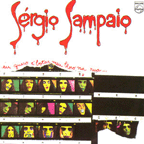 Sergio Sampaio "Eu Quero E Botar Meu Bloco Na Rua" (Philips, 1973) (LP)
Wow. Supercool. Rocker Sergio Sampaio made this album after working with Raul Seixas on his oddball album, Sociedade Da Gra-Ordem Kavernista Apresenta Sessao Das Dez, the record that got Seixas fired from his job at CBS records. If you originally got onto the Brazil bandwagon through psychedelic rock bands such as Os Mutantes, and have been looking for something that lived up to that kind of promise, then you have got to check this album out!! A weird but alluring, trippy, semi-orchestral, semi-acoustic space rock delicacy, laced with idiosyncratic acoustic guitar noodlings... This combines the searching, impassioned drama of Gilberto Gil's best stuff with the expansive, assured eclecticism of Caetano Veloso. Yeah, I know, that's pretty big talk, but really, this is an album that will live up to your expectations. A real gem, recently reissued and well worth looking for.
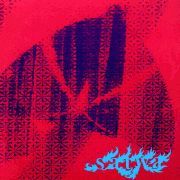 Satwa "Satwa" (Rosemblit Records, 1973) (LP)
A groovy psychedelic curio from hippie-era Brazil... This noodly, mostly-all-acoustic, mostly-all-instrumental album has a folk-freak feel that could as easily have been recorded in upstate New York or in a yurt in Southern California... It's basically a long, spaced out jam session between two stringed instruments, a folkie 12-string and a zither-like sitar, producing faerie-like riffs that just go on and on. It's broken into ten separate tracks, but they all sound the same, as if the musicians -- the post-tropicalia duo of Lula Cortes and Lailson -- were, y'know, like, really, really high and, like, really, really digging the groove, man, and exploring it as far as it would go. Like, totally. Tudo azul, dude. One track on Side Two features Robertinho Do Recife on electric guitar along with some spacy, half-hummed vocals, but the mood remains the same, and they quickly revert to pure acoustic music for the last two tracks. The thing of it is, though, it's a really pretty, narcotically pleasant album. It's odd, it's indulgent, it was a totally kooky project, but it holds up really well, decades later. Do you dig Davendra Banhart? Then check these guys out, too. You'll be psyched.
 Secos & Molhados "Secos & Molhados" (MCA Records, 1973) (LP)
Psychedelic glam-folk from Sao Paulo, with convincingly androgyne vocals by Ney Matogrosso. Vocally, he sounds a lot like Rita Lee, and I mean that in the best way... Os Mutantes fans should really get off on these records, which build on the same nutty rock'n'roll eclecticism. What else can I say? This is cool. Some of the best Brazilian rock I've heard yet, with sly wisps of acoustic folk, forro and space rock skillfully woven together. Highly recommended!
Secos & Molhados "Secos & Molhados" (Continental Records, 1974) (LP)
More, please.
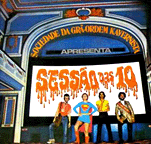 Raul Seixas "Sociedade Da Gra-Ordem Kavernista Apresenta Sessao Das Dez" (CBS Records, 1971) (LP)
This was the album that apparently got rocker Raul Seixas fired from his day job as an arranger and studio musician at CBS. Legend has it that Seixas waited until a time when the company president was out of town, then "OK-ed" the production of his own solo album, which was predictably a nutty, psychedelic mess, made with fellow kook-rocker Sergio Sampaio. The CBS exec got back later, but too late to stop the album from coming out, and dutifully booted Seixas out on his butt. I actually haven't heard the album yet, but I sure like the story.
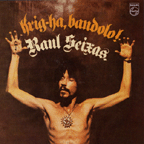 Raul Seixas "Krig-Ha, Bandolo!" (Philips, 1973) (LP)
That's Tarzan talk in the title, for all the uninitiated... This is really cool, kooky album, much mellower in tone and more acoustically based than his later hard-rock approach. The first side of this is album is filled with searching, folky space-rock, psychedelic adaptations of samba and Northeastern forro, and even a send-up of a Mitch Miller-style square dance hoedown, and some country-rock in the second half of the album. It's possible that the production assistance by bossa nova elder Roberto Menescal helped soften things a bit, but regardless of the circumstances, this is a wildly diverse, creative and rather unusual Brazilian rock album... well worth tracking down and checking out! Novelist Paulo Coelho co-wrote about half the songs on here; the start of their long and productive partnership.
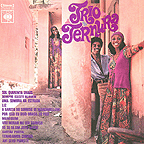 Trio Ternura "Trio Ternura" (CBS) (1971?)
A cool psychedelic soul-pop album, produced under the auspices of crazed, ne'er-do-well avant-rocker, Raul Seixas, who was just about ready to get kicked off the CBS label himself for greenlighting his own solo album without the label head's approval. Enough about him, though... This album has some great '60s pop twists, LA-style orchestral stuff, cannily blended with driving funk, similar to early Sly & The Family Stone. They later released an album under the name of Quinteto Ternura. Retro fans pay heed: this is an album worth tracking down!
Caetano Veloso - see artist discography
Tom Ze - see artist discography
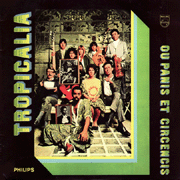 Various Artists "TROPICALIA: OU PANIS ET CIRCENSIS" (Polygram, 1968) (LP)
This is the foundational album for the tropicalia movement. A psychedelic collaborative statement of purpose for the hippie-ish tropicalia movement, with contributions from Gal Costa, Gilberto Gil, Os Mutantes, Nara Leao, Caetano Veloso and Tom Ze. Gal sings on four of the twelve tracks, and her vocals are consistently pleasant, although this is really a songwriting and stylistic showcase album which overshadows vocalists. Overall, this record radiates youthfulness and a playful, experimental artistic zeal. Recommended!
 Various Artists "TROPICALIA: A REVOLUTION IN SOUND" (Soul Jazz Records, 2006)
A top-notch collection of Brazilian psychedelic classics, featuring all the big-name stars of the brief-lived tropicalia scene of the late '60s and early '70s. I haven't actually laid eyes (or ears) on this disc, and probably won't anytime soon, since it's kinda pricey and I've also already heard pretty much all the music that's gathered here. But for an introduction to some of Brazil's greatest musicians -- Gilberto Gil, Caetano Veloso, Gal Costa, Jorge Ben and others -- this is a pretty cool set. Definitely worth checking out if you're curious about the style. (For more info on tropicalia, check out my Brazilian Music Guide... )
Various Artists "TROPICALIA: A REVOLUTIONARY MOVEMENT IN SOUND" (Universal Latino, 2007)
 Various Artists "TROPICALIA ESSENTIALS" (MCA/Hip-O Records, 1999)
I guess with the latest corporate shake-up/merger mania, The Corporation gave these guys the nod to put out their domestic reissues of classic tropicalia material. So far, so good. Even though the sound on here doesn't seem as crisp as the Philips originals, the song selection is good, although it sticks to the softer, more melodic side of the genre... This is all pretty classic material from Caetano Veloso, Gilberto Gil, Gal Costa, Os Mutantes, and others. (It's a pity they didn't consider Jorge Ben's late-'60s stuff to officially be part of the tropicalia scene, 'cause that's the one thing that's really missing from here.) One nice rarities inclusion is a track from famed arranger Rogerio Duprat's elusive solo album... Also, the liner notes have a nice essay from Ricardo Pessanha, co-author of the fabulous book, The Brazilian Sound... If you're looking for an introduction to tropicalia, this is a fine place to start.


Other Brazilian Styles
Main Brazil Index
