Marion Abernathy "The Chronological Marion Abernathy: 1947-1949" (Classics Records, 2001)
Uptempo postwar R&B from the swinging West Coast-LA scene... Abernathy was a transplant from the Midwest who recorded "Voo-It! Voo-It!," one of the first hits for blues record mogul Art Rupe (who later founded Specialty Records). This disc collects twenty tracks she later cut for the King label, backed by Hot Lips Page and other swingin' players of the time. I like this kind of jumpin' blues, but frankly, a little of it goes a long way, and Ms. Abernathy was not first-flight talent. This is fun, but it wears thin after a few tunes.
 Arthur Alexander "Lonely Just Like Me: The Final Chapter" (HackTone Records, 2007)
(Produced by Ben Vaughn)
One of the finest soul singers of the 1960s, Arthur Alexander was primed for a comeback in 1993, when Nonesuch Records commissioned a new album, Lonely Just Like Me, which showed Alexander to be a still-powerful performer -- cool, calm, authoritative and full of feeling. Sadly, he passed away from a heart attack just days after the record came out. The news of his untimely death overshadowed the record itself, so this new edition is a much-welcome revival of an excellent soul album. Also included is an interview and live performance from NPR's Fresh Air program, which further gives present-day listeners an opportunity to rediscover Alexander's charm.
Annisteen Allen "The Chronological Annisteen Allen: 1945-1953" (Classics Records, 2004)
Another West Coast songbird whose vocal style is appealing but limited, and whose repertoire includes a lot of by-the-numbers uptempo R&B tunes... This was okay, but I'm not enough of a blues completist that I felt I had to hang onto the album. Interesting to check out, but not a keeper...
 Mr. Isaac Allen "Don't Smoke" (Horizon Music, 2010)
(Recorded by Vic Stephens & Matt Oestreicher)
Eclectic, soulful modern blues from pianist-singer Isaac Allen, who has a gritty, gruff-voiced, world-weary approach that brings to mind old Tom Waits, with a dash of Dire Straits and Muddy Waters in there as well. The music is multi-textured and dense, but slinky and sly as well... Gives fans a lot to chew on; it'll certainly be interesting to see where this twenty-something auteur will go from here.
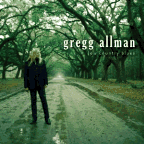 Gregg Allman "Low Country Blues" (Rounder Records, 2011)
(Produced by T Bone Burnett)
A rock-solid, pleasantly mellow roots-blues set from Southern Rock granddaddy Gregg Allman, who has seen his fair share of funky jam sessions in his time, often with a solid wall of rock-god guitars around him. This time, he's in a stripped-down, mostly acoustic mode, playing classic blues from the likes of B.B. King, Amos Milburn, Otis Rush and Muddy Waters, with a few more obscure songs in the mix and some original tunes for good measure. Underpinning Allman's B3 organ are the funky piano trills of Dr. John, and a host of tasteful pickers, including producer T Bone Burnett strumming on a tune or two. A very tasteful, tasty album, Allman's first solo set in thirteen years(!) and sure to satisfy his fans and old-school blues lovers everywhere. Definitely recommended.
Becky Barksdale "Cowgirl Blues" (Bark At The Moon, 2002)
 Lisa Biales "Just Like Honey" (Big Song Music, 2012)
(Produced by E.G. Kight)
Playfully raunchy, good-timing blues and torch songs from an Ohio gal with soul. If you loved those early Bonnie Raitt and Maria Muldaur albums, or maybe dimly recall Jo Ann Kelly, you might want to check this album out. Biales doesn't always hit the mark, but most of these tracks are pretty rich with sexy, sly innuendo and plenty of musical oompf.
 Eric Bibb "An Evening With Eric Bibb" (MC Records, 2007)
A sweet, personable live set with acoustic bluesician Eric Bibb, sparingly backed on electric bass at an unpretentious show in Sydney, Australia. Bibb is affable and open, providing low-key, unobtrusive melodic blues with a heavy dose of laid-back folkie mellowness... Introducing one song, he tips his hat towards his friend, Taj Mahal, an obvious and much-welcome influence. Although he's been around for a decade or so himself, Bibb still brings youthful promise to the genre that Taj Mahal helped define... Fans of the style will enjoy this disc; a perfect compliment to Bibb's studio work.
 Rory Block "The Lady And Mr. Johnson" (Rykodisc, 2006)
A solid, if somewhat staid, tribute to the haloed 1920s blues avatar Robert Johnson... Block plays with great earnestness and enthusiasm, though she places herself at a disadvantage tackling a whole album's worth of songs from such a foundational figure in the genre's history. It's a bit like Brandon Marsalis, et. al., playing straight, old-school New Orleans -- try as they might, it's pretty hard for modern-day devotees to recreate the same live-wire intensity as the original artists had back then -- it just isn't the same. Still, for a modern blues record, this is pretty darn good, and fans will not be disappointed. There's certainly no mistaking Block's sincerity and passion -- or her chops. She's still one of the finest blues pickers around.
 Lucille Bogan "Complete Recorded Works v.1" (Document Records , 1994)
Lucille Bogan "Complete Recorded Works v.2" (Document Records, 1994)
Lucille Bogan "Complete Recorded Works v.3" (Document Records, 1994)
Lucille Bogan "Reckless Woman: 1927-1935" (EPM Records, 1994)
Lucille Bogan "Lucille Bogan 1924-1932" (Story Of Blues, 1993)
Mississippi blues singer Lucille Bogan (aka Bessie Jackson) came from the old school of commercial blues, working as a contemporary of Bessie Smith in the early 1920s. She pretty much specialized in singing dirty songs, and is best known as the author of the immortal "Shave 'Em Dry," although, as it turns out, that was one of the least raunchy of her songs. Any of these albums may include more than enough nasty songs to satisfy the casual listener, but if you're looking for some truly shocking material from the olden days, Bogan is an artist to search out. She also frequently appears on various hokum-oriented collections. She is, of course, wildly popular with connoisseurs of the style, meriting profile pages on many blues-related websites, including
Eyeneer,
Blue Flame Cafe and
Red Hot Jazz, to name a few...
 Paul Butterfield Blues Band "The Elektra Years - An Anthology" (Elektra Records, 1997)
Of the American whiteboy blues bands of the 1960s hippie era, none had more pure firepower and panache than the Butterfield Blues Band. Fronted by the triple talents of harmonica player and lead vocalist Paul Butterfield, the lead guitars of Elvin Bishop and Mike Bloomfield, and keyboards by Bloomfield and Mark Naftalin, all this and also Howlin' Wolf's fabled rhythm section, bassist Jerome Arnold and drummer Sam Lay, who were with the integrated band at its inception. The Butterfield band was one of the few (largely) white groups that could legitimately hold its own among the electrified black blues artists (as teenagers, they had studied at the feet of the masters of Chicago's dynamic Southside scene) and they put to shame the random, drugged-out sloppiness of the psychedelic rock and jugbands of San Francisco and elsewhere: the Butterfield band knew the blues real deal, and they knew how to play it for real. Of course, that also meant that they emulated some of the sillier or more tedious aspects of the blues elders, particularly the exaggerated machismo of guitar heroes like Albert King and the torturous, agonized melodrama that passed for "raw emotion" back then, but still sounds like mannerisms and posturing now... Still, when they hit a solid groove, these guys had real chops and soul. Although they had real roots, they were clearly tapped into the folk and rock worlds, and one of the band's big claims to fame is their composition, "East/West," a 13-minute psychedelic blues jam that mixed electric urban blues with Indian raga motifs, and (at the time) was one of the longest rock tunes every recorded. Over the course of several albums, from 1965-71, the band fragmented several times, shedding various members as they pursued different projects -- Bloomfield went psychedelic and started the Electric Flag; Naftalin split for San Francisco and started his own blues band, and Bishop went off into his own brilliant, quirky explorations of Southern roots and blues. Bloomfield turned towards psychedelia and soul, adding a horn section that included sax player (and future smooth jazz star) David Sanborn. The results of these later years are mixed, though consistently interesting, and this far-ranging 2-CD set documents a vibrant, creative band, a group working at the eclectic, restless edges of the best contemporary blues and hard rock of the era. Definitely worth checking out if you are into exploring the genre-bending work of artists in the hippie years.
 Butch Cage & Willie B. Thomas "Old Time Black Southern String Band Music" (Arhoolie Records, 2006)
Good, old-fashioned fiddle-led blues, originally recorded back in the early 1960s, but hearkening back to a decades-old tradition in African-American music. This album is a fine compliment to the FOLKS, HE SURE DO PULL SOME BOW compilation that came out a while back on the Old Hat label. Like those Depression-era recordings, this set is distinguished by its raw simplicity and forthright desire to get listeners up and out of their seats, as well as to tell a good story or two. There's a distinctive flair here that sets this style apart from the mainstream of blues, as well as from "country" flavored old-time records. Definitely worth checking out!
Blanche Calloway "The Chronological Blanche Calloway: 1925-1935" (Classics Records, 1994)
Cab Calloway's older sister, Blanche started her career in the early years of blues recordings... She was a good blues growler, but it must be admitted that she had serious limitations... When she wanted to swoop up into the falsetto range, or attempted glissandi, her shortcomings as a singer became all too clear. Also, she had some really bizarre pronunciation at times... Still, she recorded with plenty of major talent -- Louis Armstrong, Cozy Cole, Ben Webster and others -- and when she had hold of a good novelty song, she cold be lots of fun. There are plenty of tracks on this disc that you don't need to listen to more than once, but a few that would be nice to keep in your early blues/jazz playlist for years to come. Generously programmed and definitely worth checking out, although maybe you don't need to knock yourself out to track this disc down.
 Clifton Chenier "Louisiana Blues And Zydeco" (Arhoolie Records, 2005)
A bonus-filled reissue of zydeco legend Clifton Chenier's first album for the California-based Arhoolie Records label, which helped bring Louisiana swamp music into the blues and folk mainstream. Chenier became the undisputed king of the genre, churning out supercharged, accordion-led dance grooves; these bluesy early 'Sixties recordings aren't quite as sweaty and funky as his later hits in the 1970s, but fans will still be thrilled to have 'em back in print, especially with added material from the ever-mysterious Arhoolie vaults. Ayyyyy-eeeeeeeeee!!!!
 Chris Cook "Remembering" (Tree O Records, 2010)
(Produced by Chris Cook & Tim Carter)
A mix of blues and twang, with funky whiteboy vocals on some songs that bring to mind Lowell George and Little Feat, with a bit of bluegrass pickin' thrown in for good measure. I'm not that into contemporary blues, but the twangy elements made for an interesting mix... Some fun songs, too -- I enjoyed "Growing Up," a lighthearted ditty about how we all get old and sometimes turn into our parents... Good indie effort; worth checking out if you enjoy DIY twang.
The Four Knights "1945-1950" (Interstate/Heritage Records, 2004)
One of innumerable blues/gospel vocal ensembles from the pre-doo wop era, the Four Knights were a southern group, with members born in North Carolina and Virginia, many of them former gospel singers who came together in the studios of radio station WBT, Charlotte, whose "Carolina Hayride" spotlighted the quartet while they were working under their original name, the Southland Jubilee Quartet. They came to the attention of record producer Cy Langois, a New Yorker who specialized in making radio transcription discs, and previously helped build the career of the Deep River Boys. Langois brought the quartet up to the Big Apple and cut a bunch of tracks with them, first just gospel material but later branching out into secular material. Langois also renamed the group The Four Knights, giving them the ability to work in either field, and sent out a steady stream of fragile transcription discs to subscriber stations across the country. It's nice material. Fans of The Three Peppers, The Mills Brothers, and other sleek vocal groups will find a lot to celebrate here... They might not have become huge stars, but these guys were pretty darn sweet-sounding. The band parted ways with Langois in the early 1950s and pursued a pop career that moved along with modest success until the decade's end. They had some tough breaks, such as when they were signed to Nat King Cole's ill-fated 1957 TV show -- a show business landmark which ended ignominiously when NBC failed to find any on-air sponsors for a program hosted by a black guy. The Four Knights staggered on until 1966, with a few lineup changes and falling fortunes, continuing to cut singles for Coral Records and lesser labels, though eventually they called it quits as rock and soul music eclipsed their older style of R&B. They left behind some pretty sweet music, though, including the two dozen-plus tracks on this lovingly assembled set. (Thanks to archivist Opal Nations for doing all the archival legwork, and for providing the detailed liner notes, which I've synopsized above... Thanks for all the great work, my friend!)
Ida Goodson "Ida Goodson Sings And Plays Church Music And Songs From The South" (CSA Records, 1975) (LP)
(Produced by Lars Edegran & Henning Schadler)
Florida-born pianist Ida Goodson (1909-2000) was the daughter of Baptist preacher who had a remarkable career playing in various blues and jazz combos in the 1920s and '30s, including a stint as the house pianist at Pensacola's Belmont Theater, and decades on the road, following the waves of popularity playing blues, New Orleans trad-jazz, and big band music, including a gig accompanying blues legend Bessie Smith. In the 1950s she came back to the church (and back to Pensacola) playing piano and organ in local congregations. This gospel album was recorded by Danish jazz fan Lars Edegran, whose CSA label had an idiosyncratic profile; Goodson also recorded some secular material, as wseen below.
 Ida Goodson "Pensacola Piano" (Florida Folklife Program, 1983) (LP)
(Produced by Landon Walker)
A thoroughly charming latter-day set from Ida Goodson, giving the young'uns a taste of her old repertoire... This album was sponsored by the State of Florida as part of an effort to document the state's cultural heritage, and comes with a highly informative insert detailing Goodson's life and career. Her personality immediately leaps out of the grooves -- from the very first notes of the very first song, she had me captivated. Side One of the album is basically Ms. Goodson and solo piano, with some occasional commentary as she tickles the ivories; on Side Two she is joined by a gospel group from the Morning Star Missionary Baptist Church Choir, which includes some youthful vocalists, and a handful of musicians (bass, drums, saxophone and trumpet, with Ida Goodson leading on piano.) The blues stuff is particularly charming, with a highlight being Goodson's novelty number "One Finger Blues," in which she explains that she started playing piano so young that at first she could only play with one finger, then gradually added more: "...And this is me playing with two fingers..." It's a pretty good schtick, and the next time I do a radio show, I'll be sure to slip that track in... This is a charming, magical album, with a similar vibe to other revival albums from old blues mamas such as Hadda Brooks and Alberta Hunter. It's nice the religious Ms. Goodson was willing to revisit her jazz years as well as the gospel stuff -- she really had a remarkable career and had a lot of history to share!
 Ben Harper & Charlie Musselwhite "Get Up!" (Concord/Stax Records, 2013)
I don't review a lot of blues on this site, but I am a blues fan, and my attention was definitely caught by the pairing of blues-pop star Ben Harper and harp player Charlie Musselwhite, one of my favorite musicians of the 1960's electric blues scene. They get pretty gritty and grungy and seem to have a good collaborative vibe, though Harper's pop tendencies come to the fore, and he generally takes the lead role on most tracks. Still, a nice vigorous album in a genre that's had trouble tapping into its roots in recent years. Definitely worth checking out.
 Corey Harris "Downhome Sophisticate" (Rounder Records, 2002)
Fans of Harris's sublime acoustic blues work may be a bit surprised to hear him cutting loose on this rollicking set of loudly amplified funk, electric blues and outright psychedelic guitar tunes (!) To call it a change of pace is definitely an understatement, but Harris is clearly doing a big "artistic growth" move. How much you like or dislike it is entirely a matter of taste -- the album is well produced, albeit often quite self-indulgent and excessive. But it may capture the ears of many modern blues and roots-oriented pop fans. An interesting career shift, to be sure!
 Corey Harris "Daily Bread" (Rounder Records, 2005)
Acoustic bluesman Corey Harris delves deeper into pop, reggae and other musical styles, including African music and a dose of off-kilter jazz, courtesy of avant trumpeter Olu Dara, who plays on several tracks. Some songs recall the softer approach of his earlier work, but for the most part this is a fairly challenging, eclectic album, and pushes at the boundaries of our expectations... It didn't really work for me, but at least he's not just another folkie doing the same stuff over and over. Those of us who favor artistic growth for its own sake will applaud Harris's efforts here...
 Wilbert Harrison "Gonna Tell You A Story -- Complete Singles As & Bs: 1953-1962" (Jasmine Records, 2014)
This 2-CD set gathers together all the far-flung singles recorded by R&B singer Wilbert Harrison in the first decade of his career, encompassing several labels and dozens of songs in a variety of styles. Like many pop fans, I'm mostly familiar with Harrison from his one big hit, "Kansas City," a million-plus seller which was famously covered by the Beatles, but which Harrison wasn't able to fully capitalize on because of a restrictive contract he signed early in his career. This is a fascinating chronologically-arranged retrospective, which in some ways maps out the creative path of countless struggling blues and pop artists in the 1950s and '60s. Many of Harrison's earliest recordings were somewhat generic and uninspired, typical of the try-it-and-see-if-it-sticks approach many indie labels took, and Harrison himself has a hard time distinguishing himself as a vocalist. Of note, however, is the persistent thread of Caribbean rhythms that surfaces on several songs, as well as early choices in repertoire that included country oldies like "Cool Water" and a remake of "Rye Whiskey." Some arrangements stand out, particularly as the technology changes and electric guitar tones get fatter and grungier, as heard on the reverbalicious instrumental "Florida Special." In 1959, after years of churning out standard-issue singles, Harrison blows the lid off things with the super-sleek, ultra-cool "Kansas City," a hit single that sold over two million copies. After that, though, he never quite gets the lightning back in the bottle, but he branches out into more soul-oriented arrangements and finally emerges as a more subtle, versatile singer. His last historic hit was "Let's Stick Together," a catchy song that was later covered by hippie-boogie rockers Canned Heat, among others, though for the most part Harrison slipped back into trying to catch up with or manufacture some kind of fad or fluke hit. Some of these songs were lackluster, and some were great -- they are all gathered together here on this superb 40-track collection, which gives an obscure old-time R&B star... Definitely worth a spin!
 Louise Hoffsten "Knackebrod Blues" (Memphis International, 2002)
For decades, the blues have become so tame and tradition-bound that hearing a new artist come along and make the style sound rough and dirty again is almost like a divine revelation: Oh, so you mean modern blues don't have to be so goddamn boring?? Wow!! So let's welcome Louise Hoffsten, a slight, plain-featured blonde whose tiny voice expands to fill in the spaces left by her a remarkably muscular electric combo. Knackebrod Blues may be the most dynamic, energizing blues album of the last ten years. More remarkable still is that Hoffsten is actually from Sweden, and that her previous albums were more in a quiet, offkilter, indierock-ish mode... Here she brings a sexy, slightly trashy, jagged-edged Joan Jett-like feel to these songs that is at once electrifying and alluring. Highly recommended. (And, yeah, the release date was in 2002, but I don't think this got US distribution until '04... So, close enough, right?)
Louise Hoffsten "From Linkoping To Memphis" (Memphis International, 2005)
I was disappointed by this disc, although I'm sure many fans of modern blues and old-school soul will find it just fine. The reason I'm disappointed is that Hoffsten's earlier albums were quite striking -- this Swedish singer had emerged as one of the liveliest, most electrifying blues singers in recent memory. Here, though, she slicks up her sound, moving from the evil sounding, pared-down rawness of 2004's Knackebrod Blues into a slicker, more overwrought R&B material, aiming for more of an Etta James or Dusty Springfield vibe than her previous take-no-prisoners approach. If you like modern blues, this disc might be one you'll really want to check out, though it wasn't exactly the direction I'd expected (or hoped) Hoffsten would take.
 David Jacobs-Strain "Live From The Left Coast" (Self-Released, 2011)
(Produced by David Jacobs-Strain)
A high-energy acoustic blues set, featuring singer-guitarist David Jacobs-Strain and harmonica player Bob beach, laying live in front of an appreciative Oregon audience. Jacobs-Strain plays with a passion and intensity that rivals Johnny Winter in his younger years, and an intimacy and spark of off-kilter originality that brings to mind Ellen McIlwane and Leo Kottke... The songs are mostly originals, with lyrics that run far afield of the usual blues cliches; in a few cover tunes, Jacobs-Strain tips his hat towards Robert Johnson, Taj Mahal and Stephen Stills, which is a pretty good summation of where he's at musically and thematically. Nice stuff - definitely interested to see where he goes from here.
 Skip James "The Complete Early Recordings Of Skip James: 1930" (Yazoo Records, 1994)
Great music, though many of these tracks have terrible sound quality. Presumably they are very rare, and I'm sure this collection is a great archival milestone, but sadly I found this disc to be semi-unlistenable. Oh, well. Worth checking out, but I didn't keep it.
 Skip James "Hard Time Killing Floor Blues" (Shout Factory/Biograph Records, 2003)
A sweeeeet set of good, old-fashioned acoustic Delta blues from the masterful Mississippian, Skip James. After getting screwed out of his royalties way back in the Depression era, James had quit the music business, and was rediscovered by John Fahey and some of his pals, who were in the midst of their epic folklore forays of the early 1960s... These tracks were recorded right after James made his stunning comeback at the 1964 Newport Folk Festival, and you would never in a gazillion years guess that the guy playing on these records had hung up his guitar for over two decades... These are sweet, soulful recordings -- quite lovely, as a matter of fact, even when James is addressing truly dark material, such as his own cancer diagnosis, in "Sick Bed Blues" and "Washington, DC Hospital Center Blues." Great stuff...!
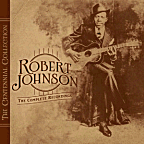 Robert Johnson "The Complete Recordings: The Centennial Collection" (Sony Legacy, 2011)
The legacy of blues pioneer Robert Johnson is well known... Well, that's actually something of an understatement: Johnson has long been lionized as the greatest bluesman ever, the creator of the blues, the guy who perfected early blues guitar, yadda, yadda, yadda... Eric Clapton and every other '60s blues player revered the guy and the legend of Johnson's "deal with the Devil" (how else could he have been so great?) has been oft repeated. I actually have some blues pioneers that I've preferred over the years - Furry Lewis, Son House, Bukka White -- but I gotta say, this 2-CD set of Johnson's complete work (29 master takes, 13 alternates) is a real doozy. The repertoire is stunning, partly because so many songs made it into the hippie-era blues canon -- "Ramblin' On My Mind," "I Believe I'll Dust My Broom," "Sweet Home Chicago," et. al -- and also because the songs themselves are so good in the original versions. These tracks have never sounded better -- although Sony issued a "complete recordings" box set two decades ago, digital sound has come a long way since the dawn of the CD era, and this new remastering sounds really sweet. Song after song, performance after performance drift out from the mist of decades with a clarity and power that is pretty impressive. If you're not familiar with Johnson's work, by all means scoop this up. And if you already have the old box set... well... you might need to get this as well: the packaging isn't as lavish, but the sound quality is tops! Highly recommended.
 Louis Jordan "The Best Of Louis Jordan" (MCA Records, 1975)
The longtime standard-issue best-of collection for this energetic, hard-rocking jump blues/jazz/R&B legend. Originally a 2-LP set, this features Jordan's biggest hits of the late 1940s, including "Choo Choo Ch'Boogie," "Caledonia," "There Ain't Nobody Here But Us Chickens," "What's The Use Of Gettin' Sober" and "I Want You To Be My Baby." Affable, but hard-rockin', Jordan proved one of the most durable musicians of the 20th Century, particularly for people who are into "researching" the roots of rock'n'roll... Several of these songs also found their way into the repertoire of the country swing band, Asleep At The Wheel, reaffirming the close ties between postwar country and blues. Great stuff! For an official, major-label release, the sound quality is surprisingly iffy at times (occasionally including scratches from the vinyl source material!), but the music kicks ass! Highly recommended -- the more you listen, the more you'll dig it!
 Louis Jordan "Rock 'N' Roll" (Mercury/PolyGram, 1989)
The title realy does say it all on this one... These are actually later recordings but the jump blues king, stuff recorded for Mercury Records in the late '50s (1956-57), about a decade after the original versions of songs such as "Choo Choo Ch'Boogie," "Caledonia" and "There Ain't Nobody Here But Us Chickens" were first laid down. This disc includes remakes of those and other tunes, as well as other pepped-up, hep tunes. Many of the arrangements are given a slightly square major-label "rock" treatment, in an obvious attempt to co-opt the booming teen scene. Lots of major talent was involved: Quincy Jones arranged and produced the first sessions, and Mickie Baker played some mean, old electric guitar.
 Julia Lee "Kansas City Calling" (Jasmine Records, 2005)
Pianist Julia Lee was the queen of the Kansas City swing-blues scene, leading a powerful big band packed with some of the best KC musicians of the post-WWII era. She specialized in raunchy, even scandalous novelty songs in which sexual matters were dealt with in honest appraisal. This is a generously-programmed single disc retrospective, with nearly two dozen tracks culled from Lee's career... Plenty of her well-known raunchy novelty songs are included -- "My Man Stands Out," "King Size Papa," "Snatch It And Grab It," "Chuck It In A Bucket," "I Didn't Like It The First Time," etc. and a couple of less-salacious numbers added in the margins. Odd that they included "Don't Save It Too Late," but didn't pair it with the companion number, "Don't Come Too Soon." Still, a pretty good introduction to her work... If nasty novelty blues tunes appeal to you, you'll definitely want to check Ms. Lee out.
 Julia Lee "Kansas City Star" (Bear Family Records, 1995)
This extensive, 5-CD box set offers a fuller version of Lee's work than the standard compilations of her risque novelty hits... Which isn't to say there isn't plenty of smut on here as well, but you also get a chance to hear her cut loose with the groovy blues riffs without the potential distraction of the novelty tropes... Pretty cool stuff!
 Julia Lee "Ugly Papa" (Jukebox Lil Records, 1995)
 Julia Lee "The Chronological Julia Lee: 1927-1946" (Classics Records, 2005)
 Julia Lee "The Chronological Julia Lee: 1947" (Classics, 2005)
 Taj Mahal "The Hidden Treasures Of Taj Mahal: 1969-1973" (Sony Legacy, 2012)
(Produced by David Rubinson, Jerry Rappaport & Taj Mahal)
One of the signature records of my hippie-era childhood, along with all the Beatles albums, Van Morrison, Joni Mitchell, and the Stones, was Taj Mahal's magnificent double album, Giant Step/De Old Folks At Home, which was probably my main introduction to the rich sounds of Delta blues and other acoustic styles. On the "pop" disc there is, of course, Taj Mahal's slyly magical cover of Carole King's "Take A Giant Step," as well as a jaunty run-through of Dave Dudley's "Six Days On The Road" and blues grooves like "You're Gonna Need Somebody On Your Bond" and "Good Morning Little Schoolgirl," all of which were staples of 1970s "free form" radio. The early '70s were a peak time for Mahal, and his presence on the hippie music scene was unique, for his mix of styles and cheerful, larger-than-life personality. This 2-CD odds/ends/outtakes collection draws on that same era, and it is a potent set of groovy, compelling material that will remind old fans of what an amazing musician this guy was... Youngsters will get a lot out of it, too: if you're into those funky jug band/old-timey tunes from the Carolina Chocolate Drops, this guy is their spiritual and musical granddaddy. Disc One unearths a dozen studio session gems featuring the same band that backed Taj on his albums, with alternate versions of beloved oldies, while Disc Two presents a full concert at the Royal Albert Hall in 1970. The live material tilts towards more upbeat, rock-oriented party material, "boogie rock," they called it at the time, while the studio tracks reveal Mahal's true genius, his visionary balance between acoustic roots music and modern, hippie-era pop -- most notably his use of the bright tones of a dobro guitar as a lead instrument in an electrified music mix. Listening back, I am struck by how much he managed to bypass rock'n'roll altogether, instead fusing deep-roots acoustic music with smoldering soul and serious funk. There are, to be sure, some spaced-out jam-band excesses, but in a good way: the smoky, erotic groove of "Yan-Nah Mama-Loo" and the sizzling, butt-shaking rhythm of "Chainey Do," are pure gold. The tracks at the end of the first disc were produced by New Orleans soul pioneer Allen Toussaint; the best of these is an experimental psychedelic banjo/wah-wah jam on the Appalachian oldie, "Shady Grove," which adds some unexpected twists to of this old-timey chestnut. Perhaps the best news of all is that this album is the herald of a reissue series that will include all of Taj Mahal's old Columbia albums... and a modern remaster of Giant Step is certainly long overdue. I'm looking forward to days to come!
Delbert McClinton - see artist discography
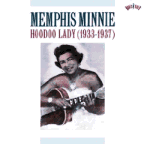 Memphis Minnie "Hoodoo Lady: 1933-1937" (Sony Legacy, 1991)
Great stuff. This disc opens up with the marvelously raunchy "Down In The Alley," and continues along with a generous selection of twenty of the best recordings made by this vigorous, dynamic, groundbreaking blues picker. A completely arresting performer, Memphis Minnie was the first gal to excel at the same game as the boys: hot guitar playing, the kind of stuff that rock'n'roll comes from. Great singer, too. This disc is one of the highlights from the outstanding Roots & Blues series which inaugurated Sony's real commitment to quality archival releases in the CD era. It's great stuff.
 Geoff Muldaur "Texas Sheiks" (Tradition & Moderne, 2009)
 Cyril Neville "Brand New Blues" (M.C. Records, 2009)
(Produced by Brian J)
A sweet solo album from drummer-singer Cyril Neville, the youngest member of the illustrious Louisiana musical royalty known as the Neville Brothers band. Not surprisingly, this record is funky and sensuous, with that distinctive, Caribbean-tinged New Orleans rhythm. Neville might be sixty years old, but he sounds as vigorous and soulful as ever, and there are plenty of good, gritty guitars behind his percussion. A strong, fresh-sounding record that's sure to make a lot of fans happy... I guess the blues aren't dead, after all!
Preservation Hall Jazz Band "50th Anniversary Collection" (Legacy Recordings, 2012)
A 4-CD, 58-track box set spanning the foundation of this legendary New Orleans institution (back in 1962) through its various incarnations over the years. This features guest performances from a host of blues, jazz, pop and folk luminaries, including bluegrass bandleader Del McCoury, folk icon Pete Seeger, hippie-era balladeer Richie Havens, Tom Wait, and many others. For more info, check out the Preservation Hall website.
 Sugar Chile Robinson "1949-1952" (Classics Records, 2003)
Meh. Novelty recordings from a preteen blues prodigy whose initial hits set the template for almost all his subsequent work: gosh, isn't it funny to hear a little kid singing raunchy blues tunes? Yes, the first time. But after a few tracks, you'll wish his producers had given him just a smidge of stylistic variety or more original material to work with. I dig the Classics label, but this was one of their few releases I released back into the wild. It's energetic and well-performed, but ultimately quite monotonous.
Sugar Chile Robinson "Go Boy Go!" (Ace Records, 2007)
 Deryck Sampson "Boogie Express: 1943-1944" (Harlequin Records, 1984) (LP)
Smooth, genteel boogie woogie solos from a seventeen-year old piano prodigy from New York, a kid who recorded a string of 78 singles for producer Joe Davis's fledgling Beacon Records label. Not electrifying, but very pleasant, and reissued here with sterling sound quality. As noted in Bruce Bastin's liner notes, these old wartime discs became quite rare, and this LP seems to have been a passion project for Bastin (as many of his Interstate Music releases obviously are...) Nice stuff.
 Bill Sheffield "Journal On A Shelf" (American Roots Records, 2006)
A robust, rolling acoustic blues set, in the tradition of John Hammond, Leon Redbone and Dave Van Ronk... Sheffield plays with self-assurance, good humor and warmth, and also displays considerable strength as a songwriter, penning all but a couple of these songs. Some are clever reworkings of old, raunchy blues themes, like "Black Bottom," while others are more folkie/confessional and poetic. Of the other tunes, a cover of Tom Waits' "Invitation To The Blues" is well-suited to Sheffield's low, growling vocals... This is a nice record, with rock-solid guitar work and admirable soulfulness and authenticity. Worth checking out!
Johnny Shines "Traditional Delta Blues" (Biograph Records, 1991)
Sweet acoustic blues, from sessions recorded back in 1972-74... It honestly doesn't get much better than this! Plenty of familiar old songs, but all presented in a distinctive, captivating personal style. Highly recommended.
Frankie Lee Sims "Lucy Mae Blues" (Specialty Records, 1992)
Rugged, tough, chunky electric blues with a stripped-down sound that harkens back to the acoustic country blues style. George Thorogood would be his left nut to sound this craggy and authentic; these 1953-54 recordings sound a lot like old Lightning Hopkins, though maybe a bit rougher in parts. It might get a little monotonous listening to this album from end to end, but each song has a bristling immediacy that'll get you to sit up and take notice. A nice slice of old-school Texas blues.
 Effie Smith "The Chronological Effie Smith: 1945-1953" (Classics Records, 2004)
Cool stuff from one of the California blues scene's great unsung heroines... Effie Smith worked with Benny Carter, Lionel Hampton and Johnny Otis before setting out on her own after WWII... Smith's background as a comedienne may help explain why her work is so much sly and expressive than many of her contemporaries; she really gets into the groove of these tunes and puts a lot of feeling into the words. She also excels at a variety of styles -- smooth ballads, uptempo blues and even a scorcher or two, such as the sizzling "I Been Down In Texas." This disc is a gem, a nice discovery for folks looking for rockin' foremothers to groove out on. The liner notes are nice, too -- Smith and her husband, John Criner, were both intimately involved in the growth of the West Coast blues scene, from their own efforts on a variety of independent labels, to the the teen-oriented R&B-pop scene of the early '60s (her son wrote the Olympics' big hit, "Western Movies," and Effie's second career as a behind-the-scener, doing promotional work for the Stax label in the '70s. At any rate, this disc is fun... Smith's approach may have been a little laid-back, but she sounded pretty darn cool.
 Tarheel Slim & Little Ann "The Red Robin & Fire Years" (Collectables, 1990)
Singer-guitarist Alden Bunn (aka) Tarheel Slim and his wife and singing partner Little Annie (Anna Lee Sanford) were cut from much the same mould as Ike and Tina Turner -- a blazing guitarist and powerful singer, A veteran of '50s R&B and group vocals, Bunn was clearly the driving force behind the duo, while Little Ann often rose to the fore in their duets with her piercing, slightly eerie voice. Slim's powerful voice is remarkable as well, and after a while you may wish they'd recorded more solo tunes -- although they both sound great, their duets don't always mesh as well as you'd want. The best tracks on this collection are electrifying, although there is a great deal of variability from track to track. For one thing, they seem to have chased several popular styles -- there's an "Unchained Melody" soundalike, a few Dinah Washington-style ballads - and these attempts to fit the sound a la mode don't always work as well as the spine-tingling blues that was really the pair's forte. But that blues stuff is pretty awesome: if you like sizzling old-school electric blues, you'll want to check this one out!
Tarheel Slim "No Time At All" (Trix Records, 1977)
 Big Mama Thornton "In Europe" (Arhoolie Records, 2005)
Oh, those lucky Europeans! Before the Stones and Yardbirds really got the point across and all the old Chess bluesmen found a welcoming embrace in the American hippie/acid rock scene, some of the most talented blues artists in the world went on long, tough European tours. Here's Big Mama Thornton, one of the greatest blues belters of her generation, wowing the old world with sidemen like Eddie Boyd, Buddy Guy, Walter Horton and Fred McDowell backing her up. These 1965 recordings were made in a British studio, but they capture the loose, funky, fiery power that the band brought to their live shows in Germany and elsewhere on the Continent. The wealth of sheer firepower and talent here is enough to make a blues fan drool just looking at the album cover -- and when you put the disc in, it gets even better! Highly recommended.
Jimmy Witherspoon "1947-1948" (Classics Records, 2003)
Jimmy Witherspoon "1948-1949" (Classics Records, 2003)
Jump blues from one of the masters of the genre. Although it's a style whose charms wore off on me -- too many abrasive instrumentals in the early 'Fifties -- an entire set of tunes showcasing Witherspoon's vocals is enough to win me back. This disc has a couple of things going for it: first, at this point the style hadn't quite calcified into the rigid monotony of the pre-rock era, and second, Witherspoon is consistently delightful, and a much more nimble and stylistically diverse singer than many others working in the same field. Much of it's workmanlike, true, but taken in moderate doses, this still packs a kick.


