"The Spy In Black" (1939)

An early British WWII film, featuring Conrad Veidt as a German naval officer, afoot on a sinister mission in the Northern UK. This film was apparently the first pairing of director Michael Powell and producer Emeric Pressburger; the plot is pretty thin, but has a few interesting, offbeat Powell-ian moments, including a great comedic scene when Veidt's cover is blown and he takes control of the situation. Interesting to see how, at this early stage in the war, the German baddie was still allowed the trait of military honor.
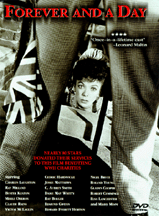
"Forever And A Day" (1943)

An amazing parade of British and American actors and international directors (including Rene Clair) lend rich, understated performances to this wartime morale booster. The destiny and spirit of England is viewed through the prism of a single country house which over the decades has become engulfed and reshaped by the bustling, energetic boundaries of London. The Trimble family fortune rises and falls, gives way to waves of modernity, and finally confronts the German Blitz, where the old family manor shelters dozens of plucky Brits in its bomb shelter basement. They sing old music hall songs as the bombs fall from above, and our present-day heroine recounts the tales of the generations of her family that have lived in the house in years gone by. Merle Oberon, C. Aubrey Smith, Ray Milland, Claude Rains, Una O'Connor, Elsa Lanchester, Brian Aherne, Reginald Owen, Edward Everett Horton, Buster Keaton and Gladys Cooper are among the dozens of celebrities who flit across the screen in well-placed cameos and episodic roles. Charles Laughton gets a brief, underwhelming role as a besotted butler (a nod, perhaps, to his great role as Ruggles Of Red Gap...) Although over a dozen writers worked on the script, and although its sentimental message (about British courage and pluck) is a bit predictable, this is an entirely effective, charming, and cohesive work... Plus... geez, when are ya ever gonna see a cast and crew like this again? A fine film, of historical and artistic interest -- well worth checking out!
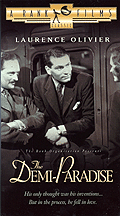
"The Demi-Paradise" (Rank, 1943)
Laurence Olivier stars in this soft-edged wartime propaganda film, which sought to promote trust and understanding between the beleagured Brits and the newfound Russian allies. Olivier plays Ivan Kouzeroff, a laconic but slightly uptight Soviet engineer who is sent to Britain before the war to broker a shipmaking deal with a local shipyard. When he arrives, he's both wide-eyed and dismissive, full of preconceptions about the coldness and venality of the English. All this, naturally, goes by the wayside over time: Ivan discovers how playful and warm-hearted the British actually are, and they give him emotional shelter before the gathering storm. Not much going on in dramatic terms, but the nudge-nudge, wink-wink look at British mores, and the "good neighbor" propaganda elements are both kind of interesting from an historical perspective. Even though his accent's a little off, Olivier's character is completely believable and charming, in his own odd way.
"A Canterbury Tale" (1944)
Director Michael Powell revisits the Blitz in this odd WWII-era interpolation of Chaucer's classic tale of travelers meeting on the path to the famous cathedral town... An interesting and unusual look at English rural life, and a quick glimpse at how day to day life in the countryside was affected by the war. With a typically offkilter, Powell-ian slant on the action.... don't worry, it all comes together in the end.
"Green For Danger" (1947)
The German "Blitz," or air war is seem briefly at the start of this mildly wacky British thriller, set during the war, and filled with odd little turns. The Inspector who shows up to solve the case (which was pretty simple) is a Kooky Character, sort of a forerunner of the BBC-TV detectives of decades to come (or a pallid echo of Poirot; take your pick...)
"The Lion Has Wings" (1940, United Artists)
An effective and explicitly propagandistic wartime docudrama, co-directed by the ever-quirky Michael Powell, and clearly aimed at a hometown audience seeking reassurance during the ongoing German Blitz. Merle Oberon and Ralph Richardson star as a British couple doing their bit to beat back the Hun, but in truth the acting parts are the least noteworthy aspect of this feature-length film, which is structured more like a newsreel than a drama. The opening sequences, which feature a clever montage that juxtoposes the wholesome, modern look of freedom-loving England with the sinister, humourless world of the Nazis, has some great footage and several interesting aspects. The apparent faith in modernity (as extolled in the newly-built high-rise tenements and lengthy footage of wartime industrial production) and the uniquely Powell-ian sense of humor which frames the narration are equally of note... The second half of the film involves a recreation of an early RAF bombing raid on the mainland, and a lengthy dramatization of how the Brits would fend off German bombers through a combination of ground artillery and plane-to-plane dogfights. The film was probably also meant to act as disinformation: we are shown an elaborate, James Bond-ish, secret control center which coordinates information phoned in by local "plane watchers," when in fact Britain had already developed a radar defense, which proved key to their success in controlling the airspace over the English Channel. Likewise, there is no mention of the controversial "lend-lease" arrangement, set up with the nominally-neutral United States, which had not yet joined the war. Finally, this pro-RAF film proved to be rather prophetic, as it was produced and released just before the airborne Battle of Britain, which was one of the pivotal fights of the War. A fascinating and somewhat quaint bit of wartime propaganda.

"Tora Tora Tora" (20th Century Fox, 1970)
A detailed look at the myriad miscalculations and complacencies that lead to the resounding success of the Japanese attack on Pearl Harbot. This dramatization of the December 7th saga concentrates on the diplomatic and espionage efforts of the Americans, and the internecine political struggles of the Japanese high command, coupled with their military brilliance and the sheer luck they encountered attacking Hawaii. Most remarkable is the even-handedness with which this film presents both sides of the story, and exposes the follies of both military groups (Japan in making an attack that provoked American mobilization, and the USA for ignoring their not-so-subtle intentions). It's a pretty good narative, although all the characters are strictly defined by their jobs, and there's little exploration of their personalities. Cool historical film, though... worth checking out!
"The Wings Of Eagles" (MGM, 1957)
John Wayne stars in this sluggish war-related Technicolor bioflick profiling Navy aviator-cum-Hollywood screenwriter Frank Wead, who (apparently) was influential in developing naval strategy before and during WWII... It's not gripping or as grim as Ford's similarly reverential "They Were Expendable," but it works in its own way. Dan Dailey steals scene after scene as Wayne's salty Navy sidekick, as does Ward Bond who has a delicious role as John "Dodge", lampooning the director himself, who apparently brought Wead to Hollywood. Maureen O'Hara does her Hepburn-y best as Wead's long-suffering wife. Of particular interest, plotwise, is the depictation of her as a boozy, chainsmoking modern gal, as well as the lengthy exploration of Wead's struggle to overcome a severe physical disability, which kind of undercuts the smothering machismo of the pre-feminist military world. Nice use of stock footage, too. Not Ford's best, but he definitely makes it better than it would have been otherwise.
"Star Spangled Rhythm" (Paramount, 1942)
For the lighter side of war, the enthusiasm and optimism of WWII-era America is seen in this wartime comedy which features Bing Crosby crooning the closing number. This is a flimsily-scripted wartime tossoff in which Paramount Studios hosts a patriotic all-star revue to entertain our men in uniform. Eddie Bracken is a goofy sailor back home to get a girl... Lucky for him that Betty Hutton -- in her first major role -- has her eyes set on him as well. A receptionist at the studio's switchboard, she fast-talks and finagles to get Bing Crosby, Bob Hope, Fred MacMurray and a bunch of other stars to come on board for the (spontaneous, yet amazingly elaborate) really big show, and in the process gets her man. Bing's big patriotic number at the end, which is some of the clumsiest wartime propaganda committed to film.
"A Guy Named Joe" (Warner, 1942)
One of Spencer Tracy's finest performances, playing Pete Sandidge, a foolhearty, hot-dog fighter pilot whose heroic suicide run against a German aircraft ends his WWII action days... Or does it? Well, as it turns out, Heaven has a word or two to say about that, and Pete's spirit is enlisted to help watch over and influence the training of another young American pilot. (God, apparently, was on the Allied side, and wanted all his angels to spend their postgame time helping kill Japs and Krauts, before furloughing them to the Elysian Fields...) The twist comes when Pete's protege meets and falls for his old fiance (Irene Dunne) and Pete finds his ghostly jealousy interfering with the war effort. The romantic melodrama slows things down, but this is still a fine film, and a spendid propaganda piece to boot. The social mores of the times are shown in great detail, including the can-do attitude of the American military, the flirting patterns of the servicemen abroad, and the grim realism that took the place of and sped up the normal grieving process of folks at war. Dunne's character is particularly interesting, showing a proto-feminism that may surprise modern viewers -- at the film's start she faces her sweetie Pete down over his reckless heroism, confronting him as an equal and objecting to his patronizing attitude. Finally, Tracy's brusque-but-sensitive everyman routine has never been better... Several great character actors pack the cast, including James Gleason as the crusty commanding officer, and the ever-affable Dan DeFore, as one of the new recruits. This flick may be a little maudlin, but it's deservedly a 1940s classic.
"When Trumpets Fade" (1998)
This made-for-cable WWII shoot-em-up came out around the same time as Spielberg's Saving Private Ryan, and while it lacks the artistic depth of that film, it does give some nice glimpses into the visceral horror of on the ground warfare. The focus is the bloody and all-but-forgotten fight over Germany's Hurtegen Forest, described in the soldiers in the film as "the Death Factory." Our hero is a self-serving survivor whose talent for combat leads to several unwanted battlefield promotions -- and, of course, to a restoration of his deadened sense of humanity and heroism. The forced modernism of the script -- particularly the gratuitous cursing and '90s-ish performances -- threaten to upend the film in the opening sequences, but it gathers steam and a sense of dread. Worth checking out. The only real gaping hole is country singer Dwight Yoakam's dull, scenery-chomping cameos as a bullet-headed, unsympathetic officer. It's not that bad of a performance, but I really think Dwight should re-think this whole acting career thing: his charisma doesn't translate well on screen.

"The Story Of G. I. Joe" (Lester Cowan Productions, 1945)
Burgess Meredith is perhaps a little too beatific in his portrayal of war correspondent Ernie Pyle, the much-beloved Pulitzer Prize winning war correspondent who brought the stories of everyday American soldiers home to readers back in the States. The Army infantrymen revered Pyle the way they loved cartoonist Bill Mauldin, who also had the guts and humility to slog it out in the mud with them, and let the folks back home know how they met the war with an all-American mix of grit, fatalism and good humor. The production values of this movie, with distracting backdrops and obviously artificial studio sets, don't hold up that well in comparison to the hyper-real war flicks that came in its wake, yet few movies have captured just how grubby, desolate and miserable the day-to-day lives of the ground soldiers could be. Also, an extended battle sequence filmed in the real-life rubble of a recently "liberated" Italian town is remarkable for showing just how extensive the war damage was -- it was total warfare, and it's amazing that Europe ever recovered from the devastation. A surprisingly bleak, if somewhat episodic, story, framing an iconic, groundbreaking war movie against which all others have to be measured. (One note of complaint: the DVD version has shamefully little in the way of special features, just one brief clip of the real Ernie Pyle taping a news reel interview with a couple of G.I.s saying "hi" to the folks back home, and a series of illegible reproductions of old newspaper columns under his byline... It's really inexcusable that a full-length documentary about Pyle and his reporting was not also included... Oh, well. It's still a good film.)
"Objective Burma" (Warner Brothers, 1945)
Raoul Walsh directed this gruelling, gritty, compelling war story, produced during World War Two, as the fight in the Pacific was still in full swing. Errol Flynn, in one of his least glamorous roles, stars as a hard-bitten Captain in charge of an American paratrooper unit that gets sent on a commando mission into Japanese-occupied Burma. They easily achieve their goal of destroying a strategic radar post, but are decimated while trying to return from enemy territory. The film is remorselessly well paced, tense, and manages to transcend the conventions of Hollywood's WWII combat melodramas: it is propagandistic and uses certain formulas, but it is also earthy and anxiety-provoking in a way that the grade-B war films of the era were not. The predicament of the soldiers -- stranded behind enemy lines and cut off from their support -- is made visceral in a way which few movies manage to convey, making this film a clear precursor to Platoon and Black Hawk Down. It's bleak tone and realistic portrayal of the foot soldiers, with their dark humor and fatalistic resolve, all rings true. Highly recommended.
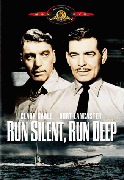
"Run Silent, Run Deep" (MGM, 1958)
A superior war film, and one of the prototypical submarine movies. Burt Lancaster and Clark Gable lock horns as the ranking officers on a WWII submarine slated for duty in the Pacific theater. Lancaster has been the ship's captain for years and has the respect of the crew, but he is abruptly displaced by Gable's Captain Richardson, a near-washout who is obsessed with breaking a Japanese blockade of a vital sea lane, after having lost his own ship there the year before. The personal tensions and resentments between the two officers are complicated by the grumblings of the crew, and by differences in naval tactics: Gable runs the crew ragged practicing for a dangerous new tactic that he's convinced will defeat the Japanese, and the sailors appeal to Lancaster for relief. A fascinating look at the frayed edges of military discipline, with a taut, well-directed script and good B&W cinematography. The shots of the exterior of the submarine are particularly nice: here's a film that lets us see how boatlike submarines actually are: you feel like you're actually up on deck, looking at every rivet and welding seam. If you go for this kind of movie, this one's hard to beat.
"The Longest Day"
"The Big Red One" (1980)
Samuel Fuller
"Lest We Forget" (1945)
This WWII documentary was commissioned by the US Army to make a record of the efforts of the ground infantry in the liberation of Europe, and was finished in 1945, just after the surrender of the German forces. However, its tone was judged too pessimistic by the military brass, and not in keeping with the positive propaganda message that was desired in postwar PR. Thus, this 1995 VHS edition was the first "official" release of the film, a full fifty years after the film was completed. You can sort of see why it was suppressed: the sneering, angry venom directed towards the Germans -- soldiers and civilians alike -- was hardly in keeping with the smiling, benificent conqueror ideals of the newly-hatching Marshall Plan, and the bitter, cynical, Mauldin-esque recounting of the miseries endured by American GIs was also kind of a downer, as were the gruesome pictures of the liberated Nazi death camps. Decades later, much of what it reveals militarily and historically has become old hat, but the film is still powerful both for its relentless momentum and as an extreme relic of nationalistic propaganda. The film's most amazing and unique images include an encounter with a troop of American GIs and the recently conquered German locals -- the soldiers stage an American-style rodeo as a form of friendly entertainment, as the weary, haggard Germans look on, with hatred in their eyes. Days, or possibly hours, before, many of these same teenage boys probably had rifles and machineguns in hand and were shooting it out with the same American troops. The decimation of the German cities and countryside is made manifestly and chillingly clear, and the grim footage of the moonscapes that were once major towns and cities, culminating in the demolotion of the Nazi arches at Nuremberg, is pretty amazing. Worth checking out if this kind of history interests you.
"Back To Bataan" (RKO, 1945)
A hearty, but hamfisted, formulaic WWII propaganda film about the liberation of the Phillipine Islands from the Japanese occupation, loosely based on contemporary history. Future McCarthy snitch Edward Dymytrk directs; a handsome young John Wayne is the white guy who organizes the guerilla resistence, and Anthony Quinn is cast in one of his many "ethnic" roles, as the grandson of a legendary Filipino political figure who is now called upon to lead his people to freedom. Although there's plenty of "good neighbor policy" talk about the nobility and can-do spirit of the Filipino people, this jingoistic, bluntly-scripted film is mostly pretty patronizing... And of course, "the Japs" are just pure, conniving, buck-toothed evil. The script is pretty action-packed, though... if you like shoot-em-ups, this is OK, if you don't think too much about the plot or the social overtones. Really nice B&W cinematography.

"It Happened Here" (1966)
The banality of evil is amply dramatized in this creepy English "what if" story, which tells the hypothetical story of what happened to Great Britain after the (fictional) defeat at Dunkirk, and subsequent triumph of the British blackshirt movement. Propaganda techniques and Nazi philosophy are skillfully shown at work in a German-run, wartime London. The ideology itself is less terrifying than the easy, matter-of-fact way that the characters adopt it, an entirely plausible and horrifying pragmatism which meant to mirror the German experience and project it onto a nation supposedly immune to the lure of totalitarianism. If this independent film had been made in today, it could be subtitled "England's Willing Executioners..." As deceptive on as many levels as the movement it depicts, this is a genuinely horrific, economically rendered movie, worth checking out, lest we be doomed to repeat the lessons of pseudo-history.