"All Quiet On The Western Front" (1930, Universal)


A powerful indictment of the tragedy of WWI, as seen through the experience of a German squadron, drawn from an elite German school. The bright-eyed enthusiasm and esprit de corps of the youthful recruits is relentlessly ground down under the weight of bombardments, starvation, grime, bloodshed and indifference. As the film's hero, Paul, declares in his famous speech at the film's end, dying for one's country isn't glorious -- "it's dirty and it's painful." Beautifully shot in black and white, this film slowly, mercilessly, artfully rachets up the tension, with battle scenes and psychological dramas that are literally and figuratively gut-wrenching. This celebrated film, made a decade after the end of the First World War, summed up the disillusioning pall the war cast upon its generation with much the same cathartic power as the movie Platoon would, more than half a century later. It's pretty strong stuff, surprisingly so for the time; an early talkie, it suffers soundwise in scenes with dialogue, but is crushingly powerful in its use of battlefield sound effects. Lew Ayres, who plays Paul, is both magnetic and intense, as his Leonardo Decaprio baby face hardens into an anger-filled John Wayne-ish mask. Although this film established many of the conventions of the war genre, it did so unsentimentally, thus escaping the cliched feel of its many imitators.
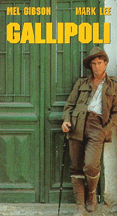
"Gallipoli" (1981)
One of the great antiwar films made in the post-Vietnam War era. This is a sensuous, elegaic look back at the tragedies of World War I, as seen from the vantage point of the colonially-minded Australians, who rushed to enlist in Britains defense against the rapacious Hun, only to discover that the English could treat them as poorly as they did the Irish, East Indians and other little people. The battle of Gallipoli, in Turkey's Suvla Bay, is one of the great examples of the military mind working at its worst. Thousands of young Australians were thrown at an unconquerable position as British troops were being held back in the rear, being saved for another engagement which, unbeknownst to the ramrod commanders, had already been won. Communication lines had been cut, and runners sent to relay messages from field commanders were unable to reach the higher-ups in time to prevent the disasterous final charge. Typical of director Peter Weir, most of this film is devoted to the set-up, and little to the slaughter... For some reason this gives the film more emotional oompf than your standard-issue shoot-em-up war flick. Plus, this is pretty much the only film in which I can concede the much-vaunted sex appeal of blue-eyed Aussie studmuffin, Mel Gibson. He's pretty adorable portraying a young back country ne'er-do-well, reluctantly drawn into the war by his wide-eyed patriotic pal, played perfectly by the perky, incandescent Mark Lee. (By the way, whatever happened to Lee? This seems to be about the only film of note he ever starred in... How odd.) A good film, and painfully historically accurate.
"The Dawn Patrol" (Warner Brothers, 1938)
An outstanding -- and rather bleak -- war movie, featuring Errol Flynn and David Niven as two dashing but harrowed, hard-drinking WWI fighter pilots, whose front-line unit is a constant revolving door of fresh-faced "replacements," new cadets who lack the basic skills to keep them alive for even a day or two, against the seasoned German pilots based only miles away. Basil Rathbone plays the British base's high-strung commanding officer, who feels every death as a personal blow -- following heartless orders, he sends boy after boy to an inevitable death. The tables turn when his promotion comes in, elevating the hotheaded and resentful Flynn to his position as commander, and Flynn's grief takes on an added dimension, as he becomes the one responsible for issuing the orders that transform eager young men into mere cannon fodder. The film is a typical interwar mix of pacifist-tinged pessimism and old-world chivalry: the men are gallant and brave, but resentful of the higher-ups who created and orchestrate the wars they have to fight in. The script is fascinating, with the action of the first half taking place entirely on the base. Rather than see the aerial combat, we see the psychological after-effects of the heavy personnel losses. When we do see combat, it is deflationary, either a framework for tragedy or a curse disguised as a giddy triumph. It's also well presented: the feel of the ungainly, canvas-clad prop planes that men went to war in is made palpable, as the ricketty machines bounce along the runway and sputter to life in the skies. A very good film, definitely worth watching.