"Private Live Of Henry VIII" (London Films, 1933)
Charles Laughton is typically wonderful in his broadly-played role as England's King, Henry the Eighth, who infamously married six different queens, divorcing or executing them as circumstances warranted. The script to this magnificent Alexander Korda production is a witty jab at English history buffs, touching only briefly on the supposed treachery of Ann Boleyn, concentrating instead on the preposterous emotional life of the lusty, capacious King. Laughton, as ever, is a marvel, skillfully presenting Henry at first as a thinly-caricatured lout, and gracefully imbuing him with gradual shades of pathos and humanity. Viewers who look to this film as historical drama are clearly missing the point: this is all about the cleverly-rendered script, which turns British schoolboy lessons on their heads, and on the classy ensemble acting, which admittedly may be hard to focus on with the lamentable quality of the current print (I'm writing in the year 2003; perhaps Criterion or some other class-act movie restoration company can correct this problem soon). Still, fans of early British cinema will enjoy this film a lot.
"Island Of Lost Souls" (Universal, 1933)
A genuinely horrifying old horror film, based loosely on "The Island Of Doctor Moreau," in which a mad scientist creates an isolated colony with experimental genetic mixes of man and animal. Charles Laughton throws himself into the villainous role, with a gusto that makes his madness entirely believable... and quite disturbing! Recommended!
"Ruggles Of Red Gap" (Paramount, 1935)

Charles Laughton is magnificent in this priceless comedic role as a proper English butler who is won over by the egalitarianism and joyfulness of American life. The actor's subtlety and reserve, and flawless comic timing make this one a winner. Yay, Charles Laughton!
"Mutiny On The Bounty" (Warner, 1935)

Charles Laughton is pure martinet evil, and Clark Cable is a sizzling hunka studmuffin in this classic version of the famous (and famously fictionalized) story of the 1787 rebellion aboard the HMS Bounty. Laughton's Captain Bligh embodies cruelty itself as he terrorizes, tortures and flogs the poor souls toiling under his command, Clark is noble and true to his morals, even as he forsakes his country in order to stand up to the tyranny of the mad ship's captain. This film is magnificently made, filmed in black & white that's as crisp and clear-cut as the plot itself... Best of all, though, is Gable at his most dashing and magnetic -- if you've ever wondered where his star appeal came from, then check this film out.
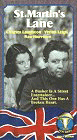
"St. Martin's Lane" (1938, Paramount)
A heart-wrenching, crushingly tender tragicomedy, showing an intimate portrait of the lives of England's professional buskers, or street performers, who were on the run in the face of the modern entertainment industry. Vivian Leigh, Rex Harrison and Charles Laughton star in this powerful film, which demolishes the pollyanna-ish conventions of the American-style, Busby Berkeley-Harry Warren musicals. Laughton steals the show as Charlie, the leader of a struggling busking troupe, in a heartbreaking performance that paved the way for his famous turn as the Hunchback of Notre Dame. Beautifully shot, but also with a dynamic and well-written script, this movie doesn't have a weak moment in it. I'd never heard of it before; now it's one of my favorite films.
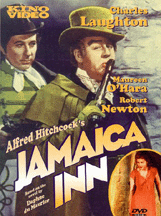
"Jamaica Inn" (Mayflower, 1938)
Laughton is delicious in this classic Hitchcock thriller as the stuffy, regal Humphrey Pengallan, a psychotic country squire who decides the best way to meet the high costs of royal life is to indulge his immodest talents as a criminal mastermind. Unbeknownst to his friends and peers, Lord Pengallan has assembled a grimy band of cutthroat thieves which he secretly directs to wreck and loot merchant ships on the rocky Cornwall coast. He is of course thwarted by plucky newcomer Maureen O'Hara and her good-looking beau, an undercover policeman whose cover is blown after one of their heists seems a bit light. Some Hitchcock fans apparently find this film less than satisfying, but it's as classy and as offbeat as any he's made; perhaps it's because the film is a period drama that folks are thrown off track. At any rate, this is vintage Hitchcock, and the character acting is typically impressive, particularly Emlyn Williams as Harry, the most menacing of the pirate crew... his is one of the most sinister screen villains you're likely to see. Laughton, of course, brings his tremendous range to bear, appearing at first as an overbearing aristocratic boor, then modifies himself to become in turns magnanimous, ruthless and finally so homicidally crazed and delusory that he takes on an almost pathetic air. And O'Hara, in her screen debut is both beautiful and full of pluck -- no helpless female here, as she stops the brigands almost single-handedly. An offbeat film, and definitely worth checking out.
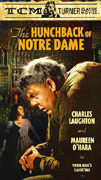
"The Hunchback Of Notre Dame" (RKO, 1939)
Charles Laughton stars as Quasimodo, the famously wretched, deformed outcast in this highbrow meditation on the evils of prejudice and the need for tolerance. Even buried under fifty pounds of latex makeup, Laughton's remarkable acting range come to bear in this role, which seems tailormade for his brand of heartbreaking soulfulness and pitiable vulnerability. The hunchback isn't the only figure worthy of compassion in this socially-conscious tale -- gypsies (a handy stand-in for Jews, on the eve of WWII), poor people and the disabled are also present on the streets of mideaval Paris, as are all varieties of blaggards and poltroons. Thomas Mitchell also makes an appearance as the king of beggars. A finely crafted Hollywood film, on the artier, more classic end of the spectrum.
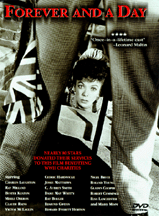
"Forever And A Day" (1943)
An amazing parade of British and American actors and international directors (including Rene Clair) lend rich, understated performances to this wartime morale booster. The destiny and spirit of England is viewed through the prism of a single country house which over the decades has become engulfed and reshaped by the bustling, energetic boundaries of London. The Trimble family fortune rises and falls, gives way to waves of modernity, and finally confronts the German Blitz, where the old family manor shelters dozens of plucky Brits in its bomb shelter basement. They sing old music hall songs as the bombs fall from above, and our present-day heroine recounts the tales of the generations of her family that have lived in the house in years gone by. Merle Oberon, C. Aubrey Smith, Ray Milland, Claude Rains, Una O'Connor, Elsa Lanchester, Brian Aherne, Reginald Owen, Edward Everett Horton, Buster Keaton and Gladys Cooper are among the dozens of celebrities who flit across the screen in well-placed cameos and episodic roles. Charles Laughton gets a brief, underwhelming role as a besotted butler (a nod, perhaps, to his great role as Ruggles Of Red Gap...) Although over a dozen writers worked on the script, and although its sentimental message (about British courage and pluck) is a bit predictable, this is an entirely effective, charming, and cohesive work... Plus... geez, when are ya ever gonna see a cast and crew like this again? A fine film, of historical and artistic interest -- well worth checking out!
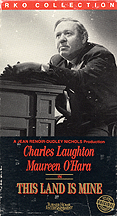
"This Land Is Mine" (RKO, 1943)
French director Jean Renoir helmed this melodramatic wartime propaganda piece, about a small town "somewhere in Europe" that falls under the heel of Nazi occupation. Charles Laughton stars as a bumbling, apolitical local, befuddled schoolteacher Albert Lory, who is forced to face up to the dastardly evil of the fascist regime while others around him either give their lives to the resistance, or collaborate with the oppressors. A talented cast balances out a stilted and rather tendentious script; Laughton, in particular, is stunning for his ability to elevate his talk-heavy closing monologue above its baldly propagandistic scripting into something resembling a stirring, dramatic speech. Fans of the cantankerous character actor Una O'Connor will definitely want to check this one out as well: playing Laughton's domineering, opportunistic mother, she gets to chew more scenery here than in any other film I've seen her in. Also of interest is the attempt to lampoon the supposed gentlemanliness of the German Army, with Walter Slezak playing the educated, insidiously manipulative officer who seeks to quell any rebellion under his command. Not a great movie, but an interesting timecapsule of sloganeering wartime propaganda.
"The Man On The Eiffel Tower" (RKO, 1949)
Burgess Meredith, of all people, directed this off-center thriller, which features Franchot Tone as an ice-cool (but quite deranged) criminal mastermind who secretly yearns to be caught, and taunts a Parisian detective, Inspector Maigret (Charles Laughton) into hounding him. The moodiness of the film's beginning is undercut by the implausibility and uneven direction of the cat-and-mouse machinations of the second half; Laughton's character loses steam and while Tone delivers some choice moments eye-bulging insanity, it's had to make heads of tails out of his overly-explicit taunts of Maigret's faltering investigation. Sort of a lesser version of The Third Man, with a resplendid mid-century Paris in place of a war-torn Vienna. Nice look at the inner workings of the Eiffel Tower as well... An interesting early adaptation of mystery novelist George Simenon's Maigret character.
"Hobson's Choice" (1954)
Charles Laughton plays Henry Hobson, a blustering, bullying 19th Century British shopkeeper who runs roughshod over his three daughters, who have kept the family shoe shop running while their widowed skinflint of a father drinks up all the profits at the neighborhood pub. At least, that is, until the eldest of the three breaks away and tells poppa where to get off. The performance that really makes this film, though, is the magnificent John Mills as the meek, hapless craftsman who she pins her hopes on. As he grows from noodge to man of means, Mills crafts one of the most endearing characters seen on screen to date. Recommended.
"Witness For The Prosecution" (MGM, 1957)
Laughton is magnificent as a curmudeonly, indefatiguable British barrister who takes on a high-profile murder case, despite a recent brush with physical collapse. Tyrone Power is his client, an oily yet earnest, desperate man, accused of murder, after his gigilo-like relationship with an elderly English matron collapses. Marlene Dietrich sizzles noirishly onscreen, playing Power's wife, a cynical, hard-as-nails German war bride whom Power brought back to London, following the War. Billy Wilder adapted this script from an old Agatha Christie story; the bangaroo surprise ending is a bit over the top, but it's all quite entertaining. Laughton fans, in particular, will get a kick out of the brisk, saucy interplay between him and his real-life wife, Elsa Lanchester, who plays the embattled home-care nurse assigned to keep an eye on Lord Wilfred, and make sure he doesn't drink, smoke cigars, or get over-excited when he returns to work. It's a losing battle, but a delight to watch. Recommended!