
7/29/02
"All Quiet On The Western Front" (Universal, 1930)
A powerful indictment of the tragedy of WWI, as seen through the experience of a German squadron, drawn from an elite German school. The bright-eyed enthusiasm and esprit de corps of the youthful recruits is relentlessly ground down under the weight of bombardments, starvation, grime, bloodshed and indifference. As the film's hero, Paul, declares in his famous speech at the film's end, dying for one's country isn't glorious -- "it's dirty and it's painful." Beautifully shot in black and white, this film slowly, mercilessly, artfully ratchets up the tension, with battle scenes and psychological dramas that are literally and figuratively gut-wrenching. This celebrated film, made a decade after the end of the First World War, summed up the disillusioning pall the war cast upon its generation with much the same cathartic power as the movie Platoon would, more than half a century later. It's pretty strong stuff, surprisingly so for the time; an early talkie, it suffers soundwise in scenes with dialogue, but is crushingly powerful in its use of battlefield sound effects. Lew Ayres, who plays Paul, is both magnetic and intense, as his Leonardo Dicaprio baby face hardens into an anger-filled John Wayne-ish mask. Although this film established many of the conventions of the war genre, it did so unsentimentally, thus escaping the cliched feel of its many imitators. (Note: for reviews of similar movies, check out my war films section.)
7/28/02
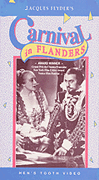
"Carnival In Flanders" (1936, Hen's Tooth Video)
A very funny, saucy French historical comedy, directed by Jacques Feyder, with production assistance by Marcel Carne (who was just on the cusp of his own directorial career)... The story is set in the Flemish town of Boom, in 1616, after the Spanish conquest of the region... When the royal troops announce their intention to billet in the town on their way across country, the village's male population proves so wimpy that it's left up to the womenfolk to save the town (led by the delightfully tart-tongued Francoise Rosay). It's unfortunate that this video version has such incomplete subtitling -- all the racier jokes are glided over, and the text is kept to a bare minimum. But even non-Francophone ignoramuses like myself get how clever and bawdy this film is. Cute. Apparently, this also had a powerful influence on many of the costume dramas which came in its wake.
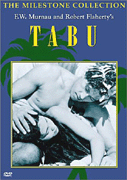
"Tabu" (1931, Milestone Video)
The last film directed by German director F. W. Murnau, before his untimely death in 1931, this is a stunning snapshot of life in the South Sea isles, featuring an authentically Polynesian (and Asian) cast, dominated by a gorgeous village of Tahitian hunks and babes. The cinematography is stunning, but the glimpse into this lost tribal life -- even to the extent that it's a culturally mediated, Europeanized view -- is fascinating. Apparently Murnau and his co-director, documentarian Robert Flaherty, had a falling-out over the direction of the film, and Murnau took the project over. Can't imagine what the tiff was over, but I suppose it doesn't matter, since the end result was such a great film. Although it's a silent picture, some traditional Tahitian music is mixed into the soundtrack, and the folk dancing -- what little of it we see -- is pretty cool, too. I don't know how much training the actors had, but the guy who plays the lead character Matahi, is super-charismatic on screen, and a very good silent actor. Wonder if he did much else after this?
"Black Narcissus" (1947)
This is an offbeat story of a young English nun's attempts to minister to a small Himalayan village, and her simultaneous struggle to rebuff and reform a virile European ne'er-do-well who was there before her order arrived. Many consider this director Michael Powell's masterpiece, although I have to confess I wasn't as taken by it as by other films of his I've seen. It's interesting and unusual, but a little too slow moving and romance-y to hold my attention.
"Time Code" (2001)
Whatever. I mean, I appreciate the experimental nature of the film -- the screen split into four separate-but-interlocking screens, each shot in a continuously-running tracking shot, filmed on digital video. The "action" shifts from scene to improvised scene, and gradually we figure out how each of the characters know each other. Still... did the story really have to be set in (yawn) Hollywood? Can't modern filmmakers think of something else to make movies about? Couldn't the actors improv their way through somebody else's life, for once? Regardless, this is one of the better uses of DVD technology I've seen -- they kept the audio tracks intact on each camera's footage, so after you soak up the edited version of the film, you can go back and see (hear, actually...) what they had to work with... Rarely do we get such a clear-cut chance to get into the headspace of the director and editor, so that at least was kind of cool.
7/23/02
"The Time Machine" (2002)
Yeesh. I mean, I expected this remake of the old H. G. Wells sci-fi classic to be kinda not good, but I never expected it would be this bad. Why would anyone want to make something this lame? Even the special effects -- which one would assume would be the film's sole saving grace -- are pretty cheesy. Oh, well. Too bad nobody can go back into the past and prevent this film from ever having been made.
7/22/02
"Les Bonnes Femmes" (1966)
A beautifully constructed, emotionally desolate look at dreams and delusions in postcolonial France. Directed by Claude Chabrol (later renowned for The Umbrellas Of Cherbourg) in a cool style that's alternately dizzying and dispassionate, this is a marvelous bit of filmmaking, full of gorgeously conceived black & white cinematography, and somewhat subtle observations of modern human nature. The swinging Parisian nightlife, which doubtless at the time appeared exotic and outlandish to foreigners, is rendered flat and desolate under Chabrol's merciless gaze, and yet the playfulness and boredom of the love-hungry, stylishly chic gals in the film's title is both compelling and heart-wrenchingly recognizable. This film drifts briefly into art-house tedium, but is rescued by its tight focus and seamless execution. For a capsule view of European youth culture ennui, try watching this one in a double feature with the Who's Quadrephenia.
7/21/02
"Notorious C.H.O." (2002) (At the Berkeley Shattuck theatre)
Kind of a disappointing followup to the brilliant and seamless I'm The One That I Want. Shot on video instead of film and with a less focused routine, this is a decent counterculture comedy concert in the transgressive Richard Pryor tradition, but doesn't reveal as much of Cho's profound human depth as she allowed us to see before. The growing subplot of her parent's parallel fame is kind of amusing: maybe it's time for Cho to start riffing on her father as well as her mom; his brief backstage interview was kind of intriguing.
"The Black Swan" (Twentieth Century Fox, 1942)
A fun, standard-issue swashbuckling pirate saga, starring Tyrone Power as the right-hand man of newly-reformed head buccaneer, Lord Morgan, who has been named governor of Jamaica... if only he can clean up the renegade factions of his former outlaw empire. And Thomas Mitchell, one of my favorite character actors, puts in a nice turn as Power's drunken Irish sidekick, Tommy Blue. Filmed in beautiful, hypervivid Technicolor with a clean, corny plot -- despite the antiquated they-like-it-when-you-treat-em-rough brash sexism of the romantic subplot, this is a pretty enjoyable no-brainer. Grand, sweeping and goofy.
7/17/02
"Brute Force" (Universal, 1948)
Burt Lancaster stars in this tough, grim noir prison flick, in which a sadistic prison guard (a young Hume Cronyn) manipulates tensions and weaknesses to produce an explosive situation. The film's liberal message butts up against its obligatory "crime never pays" ending; the convicts are sympathetic, but doomed from the word "go." A little stagey and lurid, but overall tense and suspenseful -- the ending is a real nail-biter. Recommended.
7/16/02
"I'm The One That I Want" (2000)
Comedian Margaret Cho brings SF Bay Area alternaculture to the masses, giving bawdy, multiculti pan-sexualism a very funny, and very recognizable voice. Cho delves into the rather depressing details of her brush with mainstream fame, when the ABC television network cast her as The Star Of The First Asian-American Female Sitcom... and then proceeded to tear apart at the very identity it found so compelling. Meanwhile, she gets in all sorts of brilliant observations about Korean-American identity and the joys of being a big ole fruit fly. She's hella funny and very, very Bay Area.
"Pinero" (Miramax, 2002)
Benjamin Bratt stars as Miguel Pinero, a Nuyorican poet-playwright and habitual criminal who is credited as a seminal influence on East Coast hip-hop and boriqueno salsa culture. The acting throughout is excellent, but the episodic, disconnected narrative and style-heavy editing ultimately undercut the film. It's not simply that the presentation is nonlinear; rather, it's that the film is ineffective at explaining Pinero's relationships to his friends, lovers and his art, all of which are hazily outlined, and difficult to care about. The poet's triumphs and failings abruptly emerge then melt away, as the director and editor try to infuse their film with the same intensity and explosive, rhythmic charisma as its subject. They also seem to assume a high level of audience familiarity with the Pinero's work, and thus fail to frame him as effectively as similar artist bioflicks such as Basquiat and Before Night Falls, which more clearly defined their subjects. This probably is a brilliant film, but I found myself irritated that I had to work so hard to maintain my interest, and while I found the performances magnetic and absorbing, many other aspects were irritating and pretentious.


Joe Sixpack's Film Blog
Main Film Index
Slipcue Main Index
Copyright 1998-2006 Slipcue.Com. All Rights Reserved.
Unauthorized use, reproduction or translation is prohibited.